
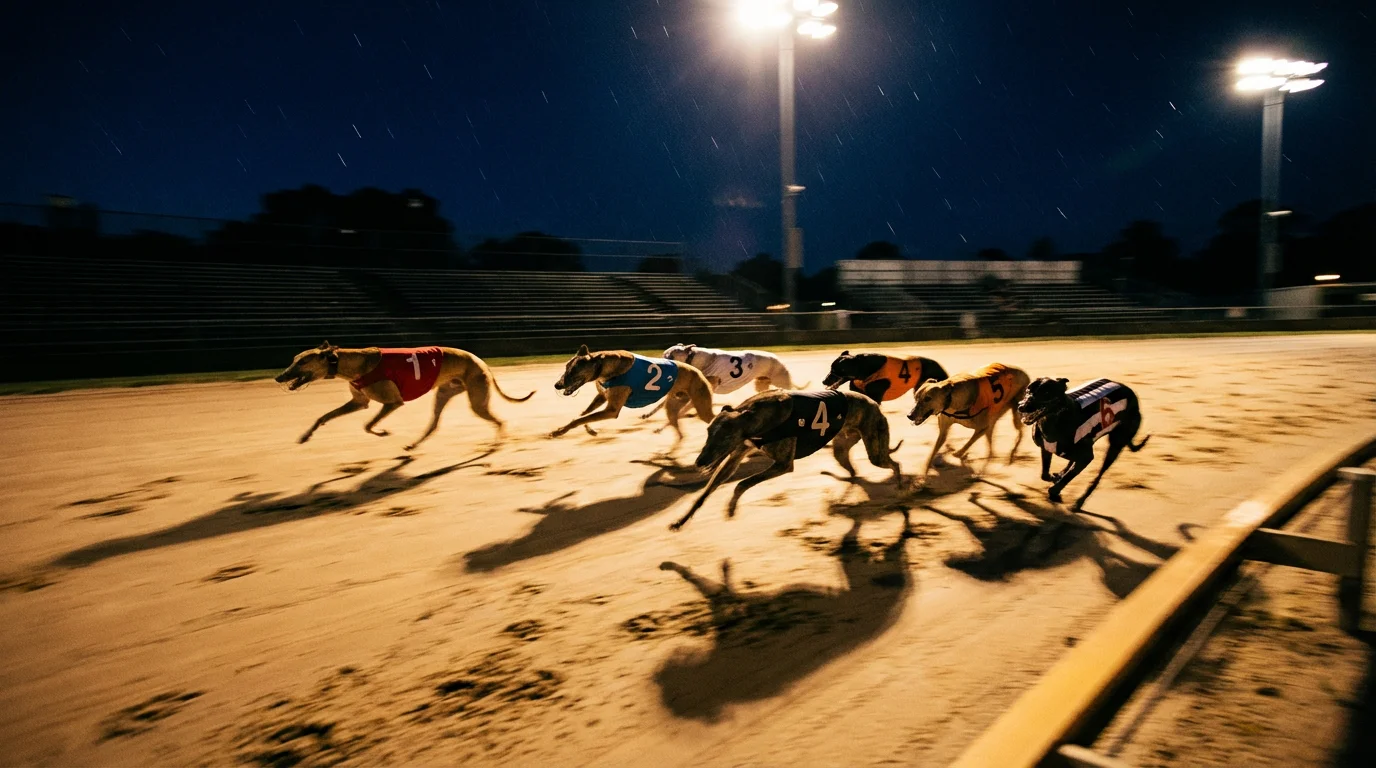
The Greyhound Derby isn't just the biggest race on the British calendar — it's the one that separates the punters who do the work from the ones who don't. Every May and June, roughly 180 greyhounds enter the competition at Towcester. Six weeks later, six remain. And somewhere between the first-round heats and the Saturday-night final, the ante-post market turns inside out, early fancies get eliminated in crowded bends, and the dogs that survive six rounds of elimination earn a shot at £175,000 under the floodlights.
This isn't horse racing's Derby, where a field assembles once and runs once. The Greyhound Derby is a knockout tournament — a format that punishes inconsistency, rewards tactical pace, and makes form analysis both more demanding and more rewarding. A dog can break 29 seconds in round one and get boxed out at the first bend in round three. A 33/1 outsider can grind through five heats on grit and trap position while the market leader sits stuck behind traffic. That structure is what makes it the single most interesting betting event in UK greyhound racing, and it's why results data from previous Derbys isn't just history — it's your best forecasting tool.
What follows is a resource built for punters, not casual readers. You'll find a complete archive of Derby results stretching back to the first final at White City in 1927, broken down by era and annotated with the betting context that shaped each period. Beyond the results, this guide covers how the odds market forms around the Derby, what the statistical record actually tells us about favourites and trap draws, how to read form across a multi-round tournament, and the betting mistakes that cost money year after year. Whether you're placing your first Derby each-way bet or refining an ante-post strategy you've been running for a decade, the aim is the same: better information, better decisions, fewer bad bets.
The English Greyhound Derby
First run in 1927 at White City Stadium. Current venue: Towcester Greyhound Stadium, Northamptonshire. Distance: 500 metres. Prize money: £175,000 to the winner. Format: six rounds over six weeks, first three qualify from each heat. Sponsored by Star Sports/TRC. Only four greyhounds have won it twice in nearly a century of competition.
The 2026 Derby will mark the eighth running at Towcester and the ninety-sixth edition overall. The ante-post market typically opens after the Irish Derby and trial stakes have provided the first meaningful form lines. If you're reading this in the months before the competition, you're already ahead of most — because the punters who engage early, study the data, and understand the tournament structure are the ones the bookmakers least want to see walking through the door.
Full Greyhound Derby Results: Every Winner from 1927 to 2025
Ninety-five finals. Ninety-five stories compressed into roughly thirty seconds of sand, speed and chaos. The Greyhound Derby has been contested almost every year since 1927 — interrupted only by the Second World War between 1941 and 1944 — and the results archive reads like a compressed history of British sporting culture: shifting venues, evolving prize money, changing demographics, and a betting market that has grown from trackside bookmakers shouting odds to a multi-platform digital industry.
White City Era: 1927–1984
The first English Greyhound Derby was run at White City Stadium in 1927, four months after the track had staged its inaugural meeting on 20 June. Entry Badge won the final on 15 October at odds of 1/4, earning trainer Joe Harmon a first prize of £1,000. The race was four bends over 500 yards, and the format was simpler than what would follow — but the principle was already in place: the best dogs in Britain, head to head, elimination rounds, one survivor.
— Entry Badge, the first Derby winner in 1927, earned his trainer £1,000 — equivalent to roughly £75,000 in today's money.
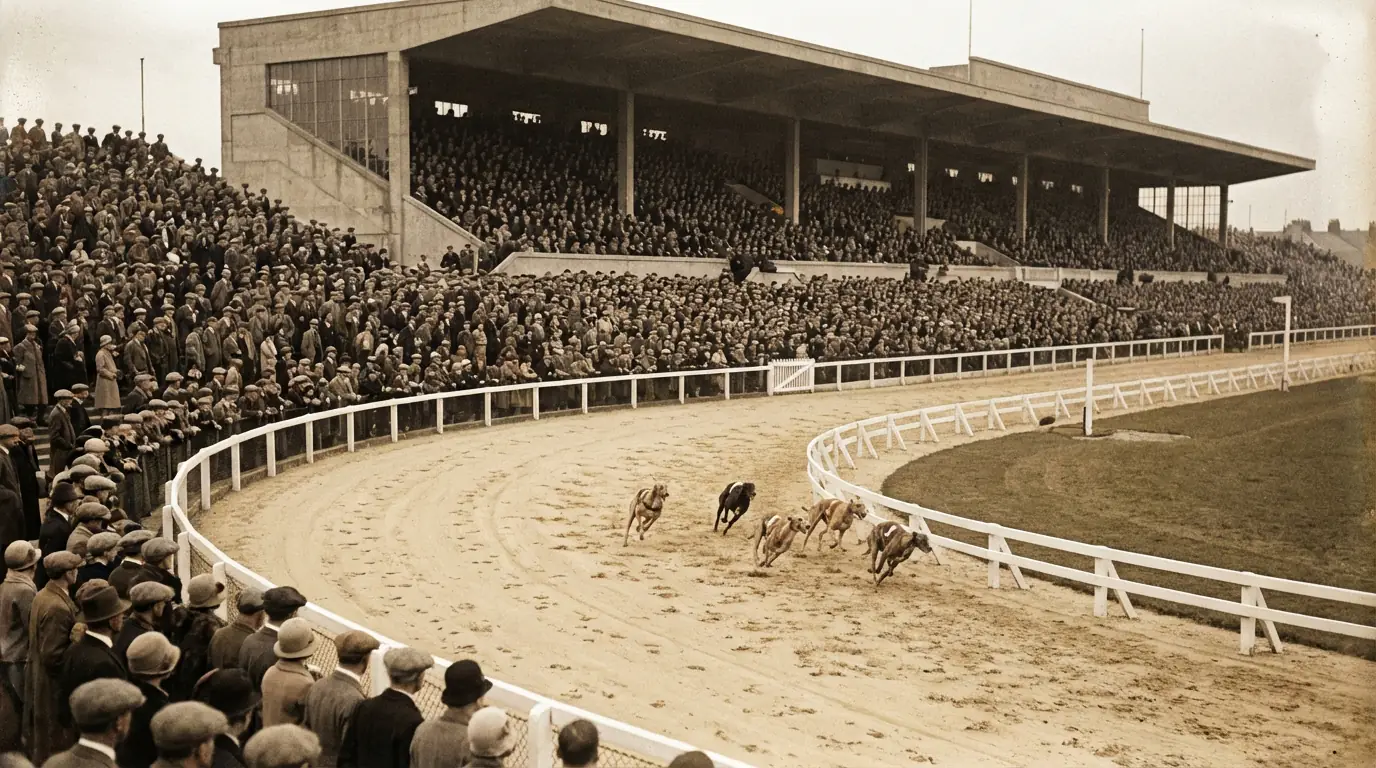
Two years later, the Derby produced its first legend. Mick the Miller won in 1929 and returned to take the title again in 1930, becoming the first greyhound to win the race twice. He didn't just dominate on the track — he became a national celebrity, appeared in a feature film, and drew crowds that turned greyhound racing into one of Britain's biggest spectator sports. For betting purposes, Mick the Miller's back-to-back wins established a pattern that would rarely repeat: only three more dogs have managed the double in nearly a century since.
The White City decades saw the Derby grow from a novelty into an institution. The distance was adjusted over the years — moving to 480 metres and eventually to 500 metres by 1975. Pet food manufacturer Spillers became the first major sponsor in 1973, the same year Patricias Hope became the second dog to win the race twice. Sponsorship increased the prize money to £35,000 by 1980, which in turn attracted stronger entries and made the ante-post market more competitive. The Daily Mirror took over in 1983, and in 1984 the Derby left White City for the last time. Whisper Wishes was the final winner at the stadium that had hosted the race for 57 years. The track closed, the developers moved in, and the sport lost its spiritual home.
From a betting perspective, the White City era was characterised by shorter-priced favourites, less market liquidity, and a punting culture dominated by on-course bookmakers. The form book was thinner, the data less accessible, and the odds shorter on the leading fancies. That changed at Wimbledon.
Wimbledon Era: 1985–2016
The move to Wimbledon Stadium in 1985 gave the Derby a new address and, over three decades, a distinct identity. The south London track was faster than White City, the crowds were vocal, and the Saturday-night final became an event — not just a race. Television coverage expanded, betting turnover grew, and the Derby's prize fund climbed alongside it.
The 1990s delivered two of the most decorated greyhounds in Derby history. Rapid Ranger, trained by Charlie Lister, won in 2000 and 2001. His raw pace and front-running style made him a bookmaker's nightmare both years — he was difficult to oppose and even harder to catch. Lister would go on to win the race seven times in total, earning the nickname "the Derby King." His record remains the benchmark for any trainer entering the competition, and ante-post punters still pay attention when a Lister-associated kennel declares entries.
ante-post — a bet placed before the final declarations, typically at larger odds with the risk of losing your stake if the dog is withdrawn.
Then came Westmead Hawk. Trained by Nick Savva, this dog won the Derby in 2005 and 2006 with a running style that was the opposite of Rapid Ranger's: last out of the traps, sweeping through the field on the final bend. His late surges at Wimbledon became the defining image of the modern Derby. Such was his popularity that Madame Tussauds created a waxwork of him — the only greyhound ever honoured in that way. For bettors, Westmead Hawk demonstrated that pace at the first bend isn't everything; a strong closer with the right draw can pick up the pieces when faster dogs get into trouble.
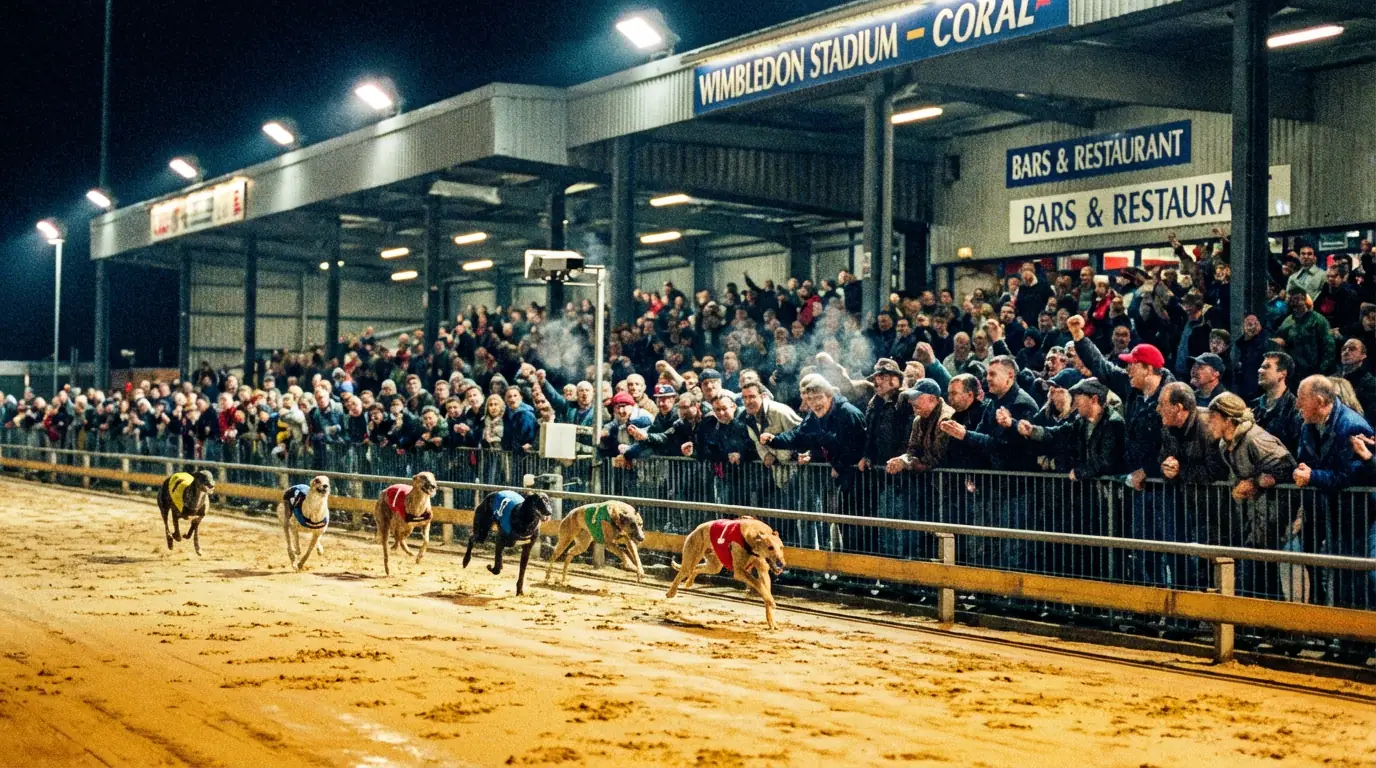
The Wimbledon era also saw the sponsorship carousel turn. William Hill replaced the Daily Mirror and Sporting Life consortium in 1998, and Blue Square later took a stint. The prize money rose consistently, reaching six figures. But the stadium's days were numbered. Property developers acquired the site, and the 2016 Derby — won by Jaytee Jet for trainer Paul Hennessy at 15/8 favourite — was the last to be held in London. Wimbledon closed in March 2017, and for the first time in ninety years, the Derby had no home.
Towcester Era: 2017–Present
Towcester Greyhound Stadium, purpose-built alongside the Northamptonshire horse racecourse, was announced as the Derby's new venue in January 2017. The track runs 500 metres over four bends with a sandy surface that demands sustained power rather than pure early speed. The transition unsettled the market: punters accustomed to Wimbledon's running patterns had to recalibrate, and the first Towcester final produced a 28/1 shock when Astute Missile won for trainer Seamus Cahill — the biggest-priced Derby winner in the modern era.
After a brief stint at Nottingham in 2019 and a pandemic-disrupted 2020, the Derby returned to Towcester in 2021 and has remained there since. The current period is defined by Irish dominance. Graham Holland, a British-born trainer based in Ireland, won in 2022 with Romeo Magico and in 2023 with Gaytime Nemo — becoming the first trainer to land back-to-back Derbys since Charlie Lister in 2010–2011. Holland's operation has reshaped the ante-post market: when he declares three or four entries, the Irish raiders tend to dominate the top of the betting from the outset.
The 2024 Derby went to De Lahdedah, trained by Liam Dowling, who equalled the Towcester track record of 28.58 seconds in the final. In 2025, the market was heavily focused on Irish Derby champion Bockos Diamond, who went off at 11/10 in the final — only to be beaten by Droopys Plunge, a 10/1 shot trained by Belgian-born Patrick Janssens at Hove. It was a textbook illustration of why Derby favourites are unreliable: Bockos Diamond was the clear best dog on form, but the six-round format, the draw, and one bad bend did the rest.
The Towcester era's defining betting characteristic is volatility. Track knowledge matters more here than it did at Wimbledon, sectional times at the first and third bends are crucial, and the strong showing of Irish-based runners means that form from Shelbourne Park and Limerick regularly translates to the English Derby. Punters who engage with Irish open-class results and trial stakes have a genuine edge over those relying solely on UK form.
Greyhound Derby Betting: How the Odds Market Works
Before a single heat is run, the ante-post market has already decided who matters. Bookmakers typically open Derby odds several months before the first round, often pegging initial prices to Irish Derby results, Easter Cup form, and trial stakes at Towcester. These early markets are speculative by nature — they're pricing potential rather than proven tournament form — but they establish the narrative that shapes how casual punters engage with the competition.
The Derby market goes through distinct phases. In the early ante-post window, prices are generous and the field is wide. A dog might be available at 33/1 based on promising trials, then shorten dramatically if it wins the Irish Derby or breaks a track record. Once entries close and the draw for round one is published, the market consolidates: the genuine contenders separate from the hopefuls, and the each-way book narrows. By the quarter-final stage, the remaining twelve dogs are individually priced with a much tighter spread, and by semi-final night the market for the final often looks like a three-horse race — or in greyhound terms, a three-dog affair.
What makes the Derby ante-post market unusual, compared to a one-off horse race, is that the odds reflect cumulative probability across multiple rounds. A dog priced at 8/1 isn't just expected to win the final — it's expected to navigate five preceding heats, avoid trouble at the bends, handle different trap draws each week, and arrive at the final in form and injury-free. Each round acts as a filter, and the ante-post price must account for the chance of elimination at every stage.
How Derby odds shift: a real-world example
| Stage | Odds | Implied Probability |
|---|---|---|
| Ante-post opening | 25/1 | 3.8% |
| After round three | 6/1 | 14.3% |
| Semi-final night | 3/1 | 25.0% |
| Final SP | 11/10 | 52.4% |
This pattern mirrors the 2025 market for Bockos Diamond, who opened around 4/1, shortened to near-even money by the final — and lost. The implied probability climbed from roughly 20% to over 50%, but the dog was beaten by a 10/1 shot.
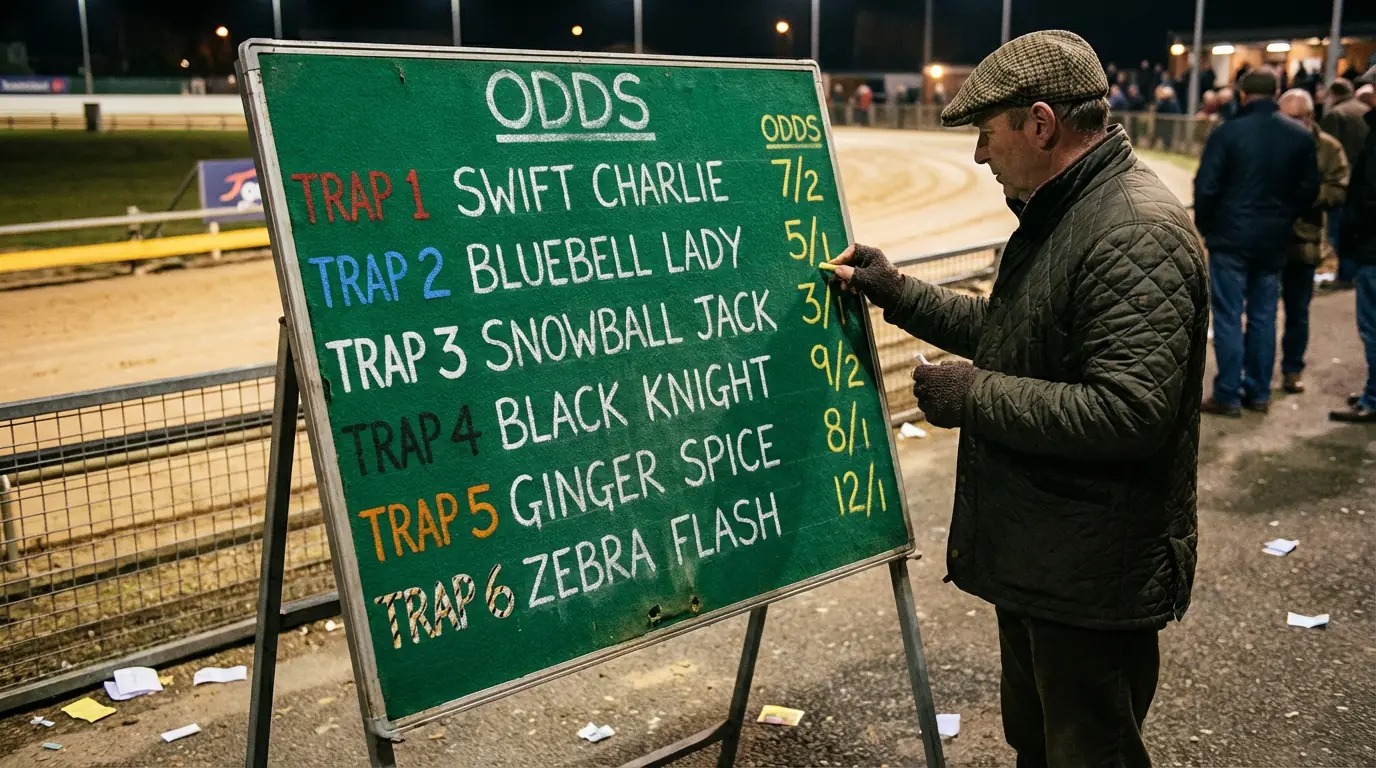
The crossover between the Irish and English Derbys is the single biggest driver of ante-post market movement. The Irish Derby, held at Shelbourne Park in Dublin, typically concludes a few weeks before the English edition begins. Dogs that perform well in Dublin arrive in the English market with proven big-race form, and trainers like Graham Holland and Pat Buckley routinely transfer their Irish runners to Towcester. Four of the last five English Derby winners were trained by Irish-based handlers, a trend that has pushed punters to follow the Irish calendar much more closely than they did a decade ago.
Trial stakes at Towcester also play a significant role. These are competitive races run over the Derby distance in the weeks before round one, and they give trainers — and bettors — a chance to assess how a dog handles the specific track. A fast trial time at Towcester carries more weight than a comparable time at any other venue, because the track's configuration, bend angles and sand composition are unique. Punters who attend trial nights or review the sectional data often have a clearer picture of a dog's Towcester aptitude than those relying solely on ante-post form.
The final variable is the draw. Each round shuffles the trap assignments, and a dog that thrives from trap one may struggle from trap five the following week. The market adjusts for this, but not always quickly enough — and that lag creates opportunities. A strong dog drawn awkwardly in the quarter-final might drift from 5/1 to 8/1, offering value to punters who understand how that particular dog handles an unfavourable box.
Key Derby Stats That Shape Betting Decisions
Numbers don't pick winners — but they kill bad bets. The Derby has a deep enough results archive to produce meaningful statistical patterns, and the punters who ignore these numbers tend to be the ones subsidising the punters who don't. Two data sets matter more than any other: the favourite's strike rate in finals, and the trap draw record at Towcester.
Greyhound Derby Favourite Win Rate
Since the Derby moved to Wimbledon in 1985, there have been 41 finals. The favourite, or joint-favourite, has won fourteen of them — a strike rate of roughly 34%. That's respectable in isolation, but it tells only half the story. Backing every favourite to level stakes across that period would have returned a loss of approximately £11.46 for every £1 staked. The market overprices the obvious.
The problem is concentrated in the modern era. Only two favourites have won the Derby in the last sixteen years. The longest consecutive losing run for market leaders was five, between 2017 and 2021, a stretch that coincided with the move to Towcester and the resultant disruption to established form patterns. The most recent beaten favourite was Bockos Diamond in the 2025 final, who went off at 11/10 — the shortest-priced beaten favourite in years — and finished second behind Droopys Plunge.
Only two favourites have won the Derby in the last sixteen years. The market overprices the obvious.
Greyhound Derby Betting Toolkit
Three data tools built from the Derby’s own historical betting record — odds movement, favourite strike rate, and each-way maths.
| Market stage | Fractional | Implied % |
|---|---|---|
| Ante-post opening | 25/1 | 3.8% |
| After round three | 6/1 | 14.3% |
| Semi-final night | 3/1 | 25.0% |
| Final SP (favourite) | 10/11 | 52.4% |
Implied probability = 1 ÷ decimal odds × 100, where decimal odds = (numerator ÷ denominator) + 1. The table shows a typical opening-to-final price compression pattern for a market leader, as seen with recent Derby favourites. Enter any fractional price to see where it sits.
Since 1985 the favourite or joint-favourite has won 14 of 41 Derby finals (34%) — a healthy strike rate that still loses money level-staked, because short-priced favourites don’t pay enough to cover the 27 losers. Try raising the win rate or the average odds to see what would flip it profitable.
Each-way splits your stake in half: win half pays full odds, place half pays a quarter of the win odds if the dog finishes 1st or 2nd. The guide notes the maths only really works from 4/1 upward — below that, a place-only result returns less than your total stake.
What does this tell a bettor? First, that opposing the favourite in Derby finals has been a profitable long-term position. Second, that the tournament format introduces enough variance — through the draw, bend trouble, and accumulated fatigue — to undermine even the most dominant dog. And third, that each-way betting on second or third fancies, rather than win-only on the market leader, tends to produce better returns over a multi-year sample. The favourite is usually the best dog. Being the best dog doesn't mean being the best bet.
Trap Draw Bias at Towcester
Towcester's 500-metre course has a long run to the first bend, which theoretically gives all six traps a fair chance to find position. In practice, the data tells a slightly different story. Since the Derby moved to Towcester in 2017, traps five and six have produced more finalists than traps one and two, largely because wide-running dogs avoid the congestion that often occurs on the rail at the first and third bends.
In Derby finals specifically, trap six has been the most successful position at Towcester, yielding multiple winners and place finishers. Trap one has the worst record in recent Towcester finals — dogs drawn inside face immediate pressure from the runner in trap two and often get squeezed at the first bend. This doesn't mean trap one can't win, but the data suggests a significant disadvantage that the market doesn't always fully price in.
It's worth noting that trap bias is distance-specific and track-specific. The statistics for graded racing at Towcester don't always mirror the Derby results, because the Derby attracts a disproportionate number of wide-running, open-class dogs who are accustomed to racing from higher traps. When assessing the draw for a Derby round, consider the individual dog's running style — railer, middle, or wide — and how that aligns with the trap assignment, rather than relying on aggregate trap stats alone.
How to Bet on the Greyhound Derby: Step-by-Step
You don't need a lifetime in the sport to place a smart Derby bet — but you do need a system. The Greyhound Derby is unlike everyday graded racing: the competition spans six weeks, the field changes every round, and the market evolves in real time. Walking in cold and betting on a name or a trap number is a fast way to donate money. What follows is a practical framework for engaging with the Derby as a betting event, from account setup to staking discipline.
The starting point is straightforward. You need a funded account with at least one licensed UK bookmaker that offers greyhound racing coverage. Most major operators — including bet365, Coral, Betfair, William Hill, Paddy Power and BoyleSports — cover the Derby extensively, with live streaming, ante-post markets and race-night specials. If you're opening a new account, look for welcome offers that can be applied to greyhound bets, but read the terms: some promotions exclude racing markets or impose minimum odds requirements that don't suit short-priced Derby bets.
Before You Stake on the Derby
- Check trial form at Towcester — has the dog run the track recently?
- Review the trap draw for the current round.
- Compare ante-post odds across at least three bookmakers.
- Set a total loss limit for the entire Derby campaign.
- Confirm whether Best Odds Guaranteed applies to greyhound bets.
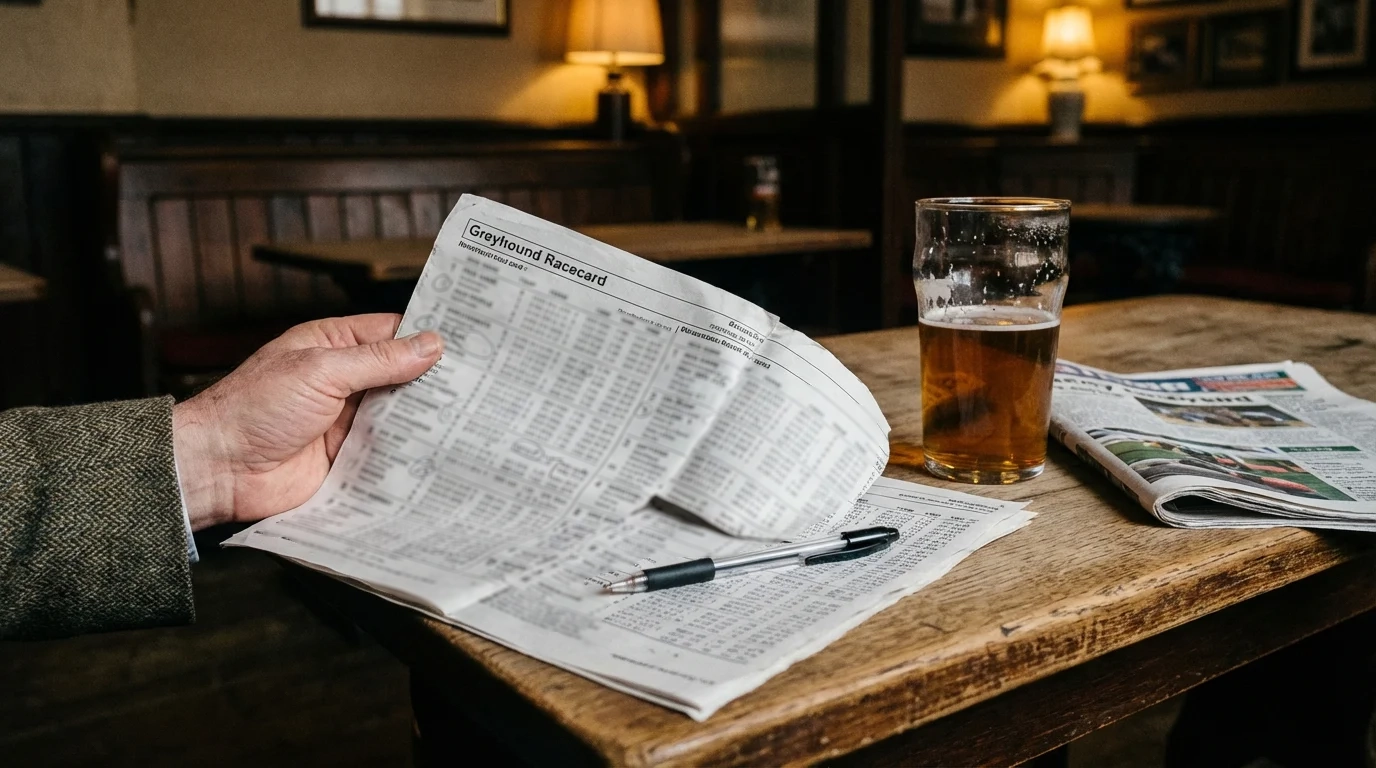
Choosing Your Bet Type: Win, Each Way, Forecast
The most common bet on the Derby is a straight win — you back a dog to finish first, and if it does, you collect at the returned odds. Simple, clean, and the foundation of most punters' approach. But the Derby's six-runner final and intense form data make it fertile ground for more nuanced bet types.
Each-way betting splits your stake into two parts: one on the win, one on the place. In standard greyhound racing, "place" means finishing in the first two, with the place part paid at a quarter of the win odds. In a six-runner Derby final, each-way can be a disciplined way to back a dog you rate highly but aren't confident will lead from trap to line. If your selection finishes second, you still collect the place portion. The maths works best on dogs priced at 4/1 or longer — anything shorter, and the place return barely covers your total stake.
Forecast betting asks you to name the first two dogs home in the correct order. The returns are pool-driven (calculated from total stakes in the forecast pool) rather than fixed odds, and they can be significant. A straight forecast on two outsiders finishing first and second might return fifty or sixty times your stake. Reverse forecasts cover both orders and cost double, while combination forecasts let you select three or more dogs and cover all possible first-and-second permutations. Tricast betting extends the concept to the first three — more permutations, higher cost, much bigger potential dividends.
For the Derby specifically, forecast and tricast bets reward punters who have a strong view on the overall race shape rather than just the winner. If you can identify which dogs will lead at the first bend and which will close from behind, you can structure a combination forecast that covers the most likely finishing orders at a manageable stake.
When to Bet: Ante-Post vs Night-of Prices
Timing is the most underrated element of Derby betting. The ante-post market opens months before round one, and the odds at that point reflect speculation more than certainty. A dog priced at 20/1 in March might be 5/1 by the quarter-finals — if it survives that long. The trade-off is clear: ante-post prices are larger, but you lose your stake if the dog doesn't make the final. There's no "non-runner, money back" in ante-post greyhound betting.
The sweet spot for most punters is after the Towcester trial stakes and before the first round. At that stage, you have tangible track-specific form, you know which dogs handle the surface, and the market hasn't yet compressed around the obvious contenders. Prices of 16/1 or 20/1 on a dog that's trialled well at Towcester can represent genuine value — provided you're willing to accept the risk of early elimination.
Night-of betting on the final is a different proposition entirely. The market is tight, the form is public, and the odds are slim. Backing the favourite at even money in the final is rarely a value play, as the historical data confirms. Where night-of betting does work is in the forecast and tricast pools, where the six-runner field creates manageable permutations and the dividends can be substantial even with modest stakes. If you've followed the competition through all six rounds and have a detailed view of how each finalist runs, the forecast market on the night of the final is where your accumulated knowledge pays off.
Reading Greyhound Form for the Derby
Form is a language. Once you can read it, you stop guessing. Every greyhound racecard — whether printed trackside or displayed on a bookmaker's site — contains a compressed record of how a dog has performed in recent races. For the Derby, interpreting that record correctly across a six-round tournament is the difference between informed betting and hope.
A standard UK racecard displays the dog's name, trainer, trap number, colour, and a line of recent form. The form line is a sequence of numbers and letters that tells you where the dog finished in each of its last six races, along with how it ran: whether it led, was bumped, ran wide, or closed from behind. The codes are standardised — "1" means first, "6" means last, "m" indicates a mid-division run, "w" means wide. These compressed annotations carry an enormous amount of information, but they only tell you what happened, not why.
For Derby-level analysis, the why matters more. A dog that finished third in a recent graded race but was bumped at the first bend and closed strongly from four lengths back is a different proposition from a dog that led and faded to third on the run-in. The finishing position is the same; the underlying performance is not. Good form readers look beyond the number and into the race comment, the sectional times, and the quality of the opposition.
Note: A dog's fastest time in a trial can mislead. Derby rounds test stamina and temperament across weeks — one fast clock doesn't guarantee a finalist.
Sectional times — the splits recorded at specific points around the track — are particularly valuable at Towcester. The first-bend split tells you how quickly a dog reaches racing position, which is crucial on a track where congestion at the first and third bends frequently determines the result. The finishing split reveals how well a dog sustains its pace over the final 100 metres. A dog with a fast first-bend time and a declining finishing split is a front-runner who tires; a dog with a slow first split and a strong closing section is a closer who needs a trouble-free passage. Matching these pace profiles to the trap draw is where form reading translates into actionable betting.
Grading matters too. Derby entries are almost exclusively open-class dogs — the highest tier of UK and Irish greyhound racing. But within open class, there's a wide range of ability. A dog that has been winning A1 races at a provincial track is stepping up considerably when it meets the likes of Irish Derby finalists and reigning champions. The grade of recent wins, the quality of the runners beaten, and the tracks where the form was achieved all feed into the assessment. Towcester-specific form carries the most weight, followed by results at other demanding four-bend tracks like Nottingham and Hove.
Finally, pay attention to a dog's racing frequency and rest periods during the tournament. The Derby demands six races in six weeks, and dogs that race infrequently in the months prior sometimes lack the fitness base to sustain peak performance through the later rounds. Conversely, dogs that have been racing every week may arrive at the semi-final physically drained. The best Derby form readers track race frequency alongside times and positions, building a picture of each contender's conditioning arc through the competition.
From the men who prepare the runners to the mistakes that cost bettors money — the margin is thinner than you think.
The Trainers Who Define the Modern Derby
Charlie Lister retired from training in 2018 with seven Derby titles. No one has come close. The man they called the Derby King won his first in 1997 with Some Picture, his last in 2013 with Sidaz Jack, and in between he produced a succession of dogs that combined pace, temperament and the physical durability to survive a six-round knockout. Lister's approach was built on preparation — his dogs were conditioned specifically for the Derby distance and ran their trials at the host venue long before the competition began. For punters, the lesson was straightforward: when a Lister-trained dog was entered in the Derby, it was entered to win it, not to make up the numbers.
The modern equivalent is Graham Holland. Based in Ireland, Holland has won the Derby twice in three years — Romeo Magico in 2022, Gaytime Nemo in 2023 — and had three runners in the 2025 final, including the ante-post favourite Bockos Diamond. His operation is the most dominant force in the current sport. He regularly campaigns multiple dogs through the Irish and English Derbys simultaneously, which gives him a tactical advantage: he can run one dog as a pacemaker to benefit another, and his intimate knowledge of each contender's running style allows him to assess the draw more effectively than trainers with a single entry. When Holland declares a team for the Derby, the market responds immediately, and his runners typically trade at shorter odds than their individual form might justify — a reflection of the trainer's record rather than any single dog's ability.
Patrick Janssens, the Belgian-born trainer based in Hove, has emerged as a potent Derby force on the English side. He won the Derby in 2021 with Thorn Falcon and again in 2025 with Droopys Plunge — the 10/1 outsider who upset Bockos Diamond. Janssens operates a smaller kennel than Holland but has a track record of producing Derby dogs that peak at the right moment. His runners tend to be underestimated by the market, which makes them interesting for each-way punters looking for value against the Irish raiders.
Among the other trainers worth tracking, Paul Hennessy — who doubles as a horse trainer — has won the Derby twice, with Jaytee Jet in 2016 and Priceless Blake in 2019. Hennessy typically brings a large Irish team and is capable of springing a surprise at double-figure odds. Liam Dowling, who trains and breeds under the "Ballymac" prefix, produced the 2024 winner De Lahdedah and consistently places dogs in the semi-final and final stages. Nick Savva, responsible for the great Westmead Hawk's double, is no longer active but his legacy looms over the event's history.
For betting purposes, the trainer is the one constant in a tournament where everything else changes week to week. Dogs get injured, draws shuffle, form dips — but the trainer's record of producing finalists is a stable data point. If you're narrowing an ante-post shortlist for the 2026 Derby, start with the trainers who have a documented history of navigating the full six rounds. Holland, Janssens, Dowling and Hennessy have all reached the final in the past four years — and at least three of them are expected to have multiple entries again this season.
Greyhound Derby Betting Mistakes to Avoid
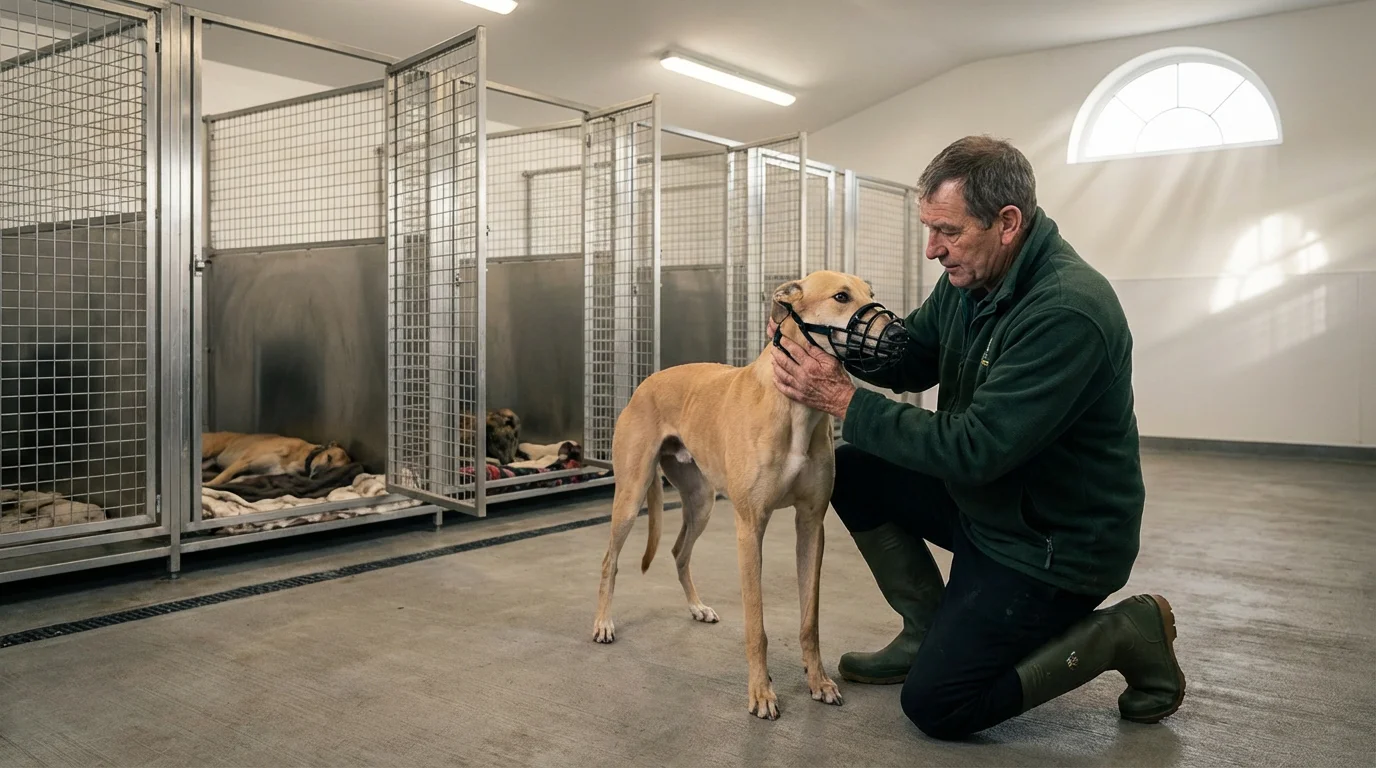
The Derby punishes lazy money faster than any other greyhound race. The six-round format, the shifting draws, and the intensity of the competition create more opportunities for the market to get it wrong — and for bettors to compound those errors through poor discipline. These are the mistakes that cost punters the most, year after year.
The first and most common error is blind favourite backing. The data is clear: favourites have a poor record in Derby finals, and the odds they're returned at rarely compensate for the risk. Betting on the favourite because it's the favourite — without assessing the draw, the pace map, or the specific conditions of the final — is not a strategy. It's a reflex. The Derby has produced enough shock results to make reflexive favourite backers significantly worse off over time.
The second mistake is ignoring the draw. Every round of the Derby is drawn separately, and a dog's trap assignment changes each week. A wide-running dog drawn in trap one faces a fundamentally different race from the same dog drawn in trap six. Punters who back a dog for the entire tournament without adjusting for the draw in each round are ignoring one of the most important variables in the competition. The draw is published in advance — there's no excuse for not factoring it in.
Third: overlaying ante-post bets without an exit plan. Ante-post betting on the Derby is attractive because the odds are generous, but the risk is real. If you back a dog at 20/1 ante-post and it gets eliminated in round two, your money is gone. Experienced punters set a total Derby budget before the first round, allocate a fixed percentage to ante-post positions, and resist the temptation to chase by adding to losing positions as the tournament progresses. The Derby is six weeks long. If your first selection goes out, the discipline is to sit, reassess, and re-engage on the basis of new form — not to throw good money after bad.
Fourth: assuming Irish Derby form translates automatically. The Irish pipeline has produced a string of English Derby winners in recent years, and that success naturally draws punters toward Shelbourne Park form. But the track in Dublin is a different configuration from Towcester, and dogs that dominate there don't always handle the Northamptonshire bends. The Irish connection is a valuable data point, not a guarantee. Punters who back the Irish Derby winner at short odds in the English version without checking Towcester trial form are making an assumption the record doesn't fully support.
✓ Do
- Compare ante-post odds across at least three bookmakers before staking.
- Check each round's draw and adjust your view accordingly.
- Set a total loss limit for the entire six-week competition.
- Study Towcester-specific trial form before the first round.
- Use each-way on dogs priced 4/1 or longer in the final.
✗ Don't
- Back the favourite purely because it tops the market.
- Stake heavily ante-post without accepting the non-runner risk.
- Ignore the trap draw when assessing a dog's chances each round.
- Assume Irish Derby form transfers directly to Towcester.
- Chase losses by increasing stakes after early-round eliminations.
The fifth and perhaps most insidious mistake is chasing losses. The Derby's weekly rhythm makes it tempting: your dog goes out in round three, and by Saturday you're looking for a replacement to back in the quarter-finals. But that replacement hasn't been researched with the same depth, the odds don't reflect your original assessment, and the bet is motivated by the desire to recoup rather than the presence of value. The punters who profit from the Derby are the ones who can watch a round without betting on it.
FAQ
How many rounds are in the Greyhound Derby and how does the format work?
The English Greyhound Derby consists of six rounds: four preliminary rounds, semi-finals and a final. Roughly 180 dogs enter the first round, which is divided across three nights of racing with six-dog heats. In each heat, the first three finishers qualify for the next round. This elimination continues through rounds two, three and the quarter-finals, reducing the field progressively. The semi-finals produce two heats of six, with the first three from each advancing to the six-dog final. The entire competition runs over six consecutive weekends at Towcester, typically from early May to mid-June. The format rewards consistency and durability — a dog must win or place highly in five successive races before contesting the final, which is why single-race form doesn't always predict Derby success.
Has any greyhound won the Derby twice — and what does that tell us about back-to-back betting?
Four greyhounds have won the English Greyhound Derby twice: Mick the Miller in 1929 and 1930, Patricias Hope in 1972 and 1973, Rapid Ranger in 2000 and 2001, and Westmead Hawk in 2005 and 2006. No dog has achieved the double since. For bettors, the rarity of defending champions tells a clear story — the six-round format, combined with different draws and a year's additional age, makes repeat success extremely difficult. Ante-post markets for defending champions tend to be shorter than the historical probability warrants. De Lahdedah, the 2024 winner, went off among the leading fancies in 2025 but was beaten in the final. Opposing a short-priced defending champion, or at least tempering expectations, has been the statistically sound approach for two decades.
What trap has won the most Greyhound Derbys at Towcester?
Since the Derby moved to Towcester in 2017, trap six has produced the strongest results in finals, with multiple winners and placed runners. The wide trap benefits dogs with a prominent early pace or a wide running style, allowing them to avoid the congestion that frequently occurs at the first bend on the inside. Trap one, by contrast, has the weakest record at Towcester in Derby finals, with inside-drawn dogs often getting squeezed in the early exchanges. However, trap bias should be treated as one factor among several. The individual dog's running style, recent form and the pace profile of the other five finalists all affect how a given trap performs on the night. A strong railer in trap one is a different proposition from a wide runner forced inside.
After the Finishing Line
Every June, the best dogs in Britain and Ireland descend on Towcester — and for one night, the sport gets the stage it deserves. The Greyhound Derby remains the pinnacle, but it exists within a sport that's smaller than it was twenty years ago. Track closures have reduced the UK circuit from dozens of venues to eighteen licensed stadiums under the GBGB. Wimbledon, the Derby's home for three decades, is now a housing development. White City is a memory. The dog tracks that once dotted every major British city have been replaced by supermarkets and apartment blocks, one by one, with little fanfare.
And yet the Derby itself has never been more competitive. The influx of Irish-trained runners has raised the standard of the competition to a level that arguably exceeds anything the Wimbledon era produced. Graham Holland's operation alone could field a full six-dog final. The prize money has held at £175,000, the sponsorship from Star Sports and Towcester Racecourse provides stability, and the live streaming revolution — through bookmaker platforms, SIS, and the Gone To The Dogs YouTube channel — has brought the Derby to an audience that would never have visited a track in person. You can watch every heat, every round, every heartbreak and every 28-second blur from your phone, and bet on it in real time. That's a fundamental shift in how the sport reaches its audience, and for the 2026 edition it means more eyes on the action than at any point in the Derby's history outside of its 1970s television peak.
For punters, the opportunity is real and growing. The Derby's six-round format generates more data, more form lines and more market inefficiencies than any single-race event. The ante-post market opens months in advance and shifts through phases that reward engaged, disciplined bettors. The statistical record — on favourites, trap draws, trainer patterns, Irish form — is deep enough to build a genuine edge, provided you're willing to do the work. The punters who treat the Derby as a six-week project rather than a single Saturday night are the ones who find value year after year.
What the next decade holds for the sport is genuinely uncertain. Further track closures are possible. The regulatory environment around gambling continues to tighten. Welfare scrutiny has increased, and the GBGB's reforms — however necessary — add operational costs that smaller tracks struggle to absorb. But the Derby, as an event, has survived venue changes, a world war, a pandemic, and the slow erosion of its host circuit. It adapts. It persists. And as long as six greyhounds line up in the traps on a Saturday night in June, the sport will have something worth watching — and something worth betting on.
The results are the foundation. The analysis is the edge. The discipline is what turns both into profit. The rest is sand, speed, and the sound of traps opening.
