

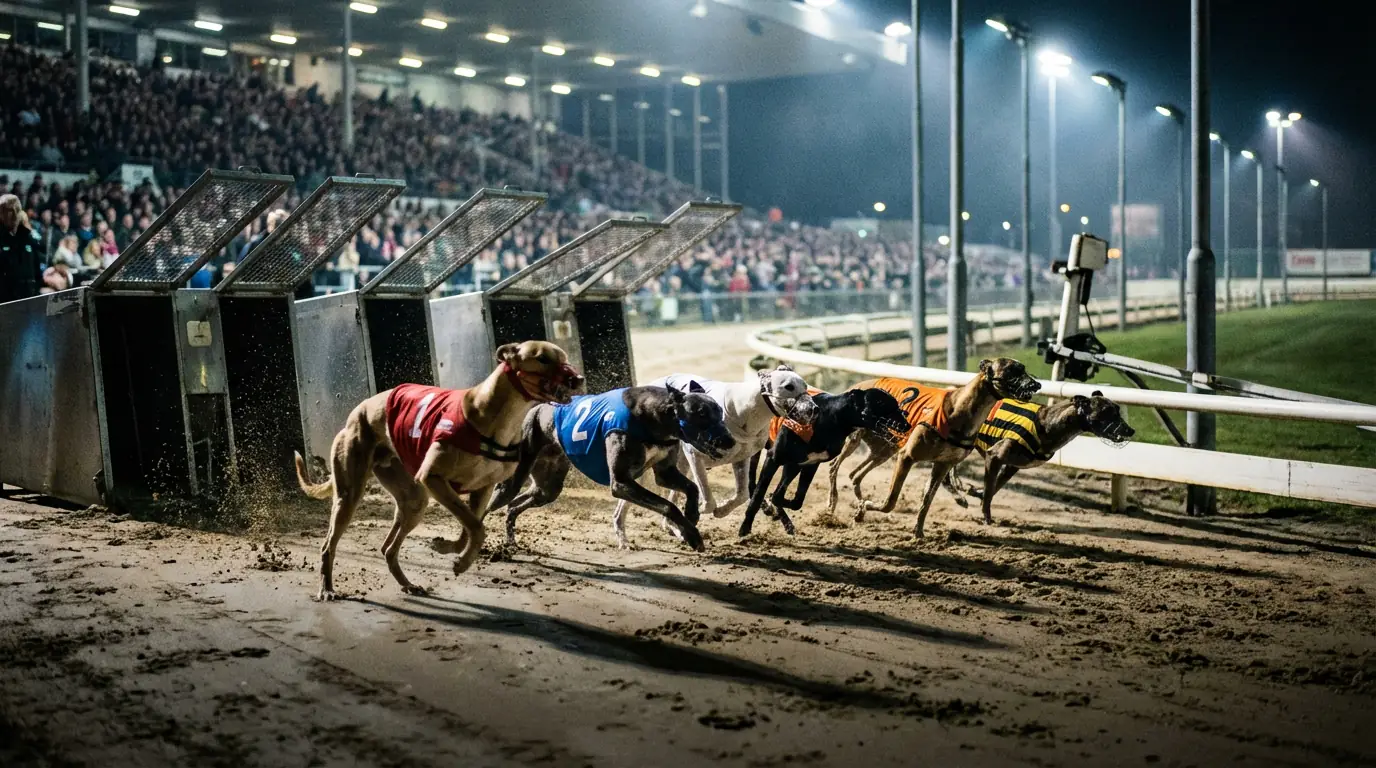
The Greyhound Derby is the one week a year when the ante-post market actually matters. For the other fifty-one weeks, greyhound betting is a nightly affair: study the card, check the draw, back a dog ten minutes before the off, collect or move on. The Derby operates on a different timescale. The ante-post market opens months before the first heat, the competition runs across six rounds over six weeks, and the odds on any given dog can shift from 33/1 to 3/1 — or collapse entirely when an injury knocks it out in round two. If you want to bet on the Derby intelligently, you need to understand how that market forms, where the data points towards value, and which mistakes cost the most money.
This is not a general guide to greyhound betting. It is specifically about the English Greyhound Derby as a betting event — the structural quirks that make it different from standard racing, the statistical patterns that recur year after year, and the strategic framework that separates punters who approach the Derby with a plan from those who show up on final night with a hunch and a tenner.
The Derby’s six-round knockout format creates a betting landscape that has more in common with a tennis grand slam than a single horse race. Each round eliminates runners, reshuffles the draw, and reprices the market. A dog that looked a bargain at 20/1 before round one might look overpriced at 4/1 by the semi-finals — not because it has improved, but because the competition around it has been eliminated. The market isn’t just pricing the dog. It’s pricing the surviving field, the draw, the track conditions, and the cumulative attrition of a six-week campaign. That layered complexity is where the opportunity sits.
The 2026 Derby will be contested at Towcester, the event’s home since 2017. Enough data now exists from the Towcester era to identify meaningful patterns — trap biases, surface speed trends, the running styles the track rewards — and to build a betting approach rooted in evidence rather than tradition. The pages that follow lay out the odds structure, the key data, the bet types worth considering, the mistakes worth avoiding, and a framework for constructing a position across the tournament. Whether you’re backing a dog ante-post in March or picking your spot on semi-final night, the aim is the same: put the numbers on your side before the traps open.
How Greyhound Derby Odds Are Formed
Ante-post prices for the Derby open months before the first round — and they’re rarely right. That’s the point. The ante-post market is a prediction engine running on incomplete data, and the gap between its initial output and the final-night starting prices represents the opportunity that Derby punters are trying to exploit. Understanding how the market forms, what drives its movements, and where its blind spots sit is the foundation of any serious Derby betting approach.
Ante-Post Market Dynamics
The Derby ante-post market typically opens in early spring, once the entry list takes shape and trainers confirm their intended runners. At this stage, bookmakers are working with limited information: last season’s open-race form, early trial times at Towcester, and — most significantly — the trainer’s track record in the competition. The initial tissue prices reflect these inputs, but the uncertainty is enormous. A dog that hasn’t raced competitively for three months might be priced at 25/1 based on its previous campaign, while a lightly raced newcomer from a top Irish kennel might open at 14/1 purely on reputation.
This early-market phase is where the biggest prices are available and where the risk is highest. Ante-post rules apply: if your dog is withdrawn, injured, or fails to qualify, the stake is lost. There’s no non-runner, no return. The bookmaker is compensating for that risk with inflated odds, and you’re accepting it in exchange for a price that will almost certainly shorten if the dog progresses. The trade-off is mechanical. The question is whether you have enough information to assess the dog’s probability of reaching the final more accurately than the market does.
As the first round approaches and trial form becomes public, the market begins to sharpen. Dogs that post fast trial times at Towcester attract attention and money, compressing their prices. Dogs that trial poorly or show signs of fitness issues drift outward. This is the first information cascade — the market absorbing new data and adjusting. Punters who have been tracking trials independently can sometimes identify dogs whose trial performances were stronger than the raw times suggest (for example, a fast sectional despite a slow overall time caused by a wide run). That kind of nuanced reading is where ante-post value tends to hide.
Round-by-Round Odds Movement
Once the heats begin, the market enters a different phase. Each round produces results — times, sectionals, race comments, trap-draw outcomes — and the odds respond. A dog that wins its first-round heat impressively, posting a fast early-pace sectional from an awkward draw, will shorten significantly for the outright market. A dog that scrapes through as a fastest loser might drift, even if its underlying performance was better than the bare result suggests.
The typical trajectory for a genuine contender looks something like this: opens at 20/1 to 25/1 in the ante-post market, contracts to 10/1 to 12/1 after winning its first-round heat, firms further to 6/1 or 7/1 following a strong quarter-final, and arrives at the semi-finals somewhere between 3/1 and 5/1 depending on the surviving field. If it reaches the final, the price compresses again — sometimes dramatically, depending on the draw and the opposition. The dog that was 25/1 in March might go off at 11/10 on final night. Every pound staked at 25/1 is worth twenty-five times more than a pound staked at evens. That differential is the entire argument for ante-post betting.
The counter-argument is attrition. Not every dog that opens at 25/1 reaches the final. Most don’t. Injuries, poor draws, off-nights, and the sheer difficulty of winning six consecutive races at the highest level mean that the majority of ante-post selections fail before the semi-finals. The skill is not in picking winners — it’s in pricing the probability of a dog surviving the tournament at a rate better than the market implies. If you assess a dog’s chance of reaching the final at 15% and the ante-post market implies 5%, you have value regardless of whether the dog actually makes it. Over enough Derbies, that edge compounds.
Derby Betting Tips: What the Data Shows
Forget hunches. Here’s what the record actually says. The Derby has been run nearly a hundred times, and the accumulated data reveals patterns that are too consistent to ignore and too persistent to be random. Two stand out above all others: the favourite’s chronic underperformance in the final, and the dominance of Irish-trained runners in the modern era. Both have direct implications for how you allocate your Derby stakes.
Favourite Strike Rate in Derby Finals
The favourite’s record in the Derby final is significantly worse than its record in standard graded racing. In a typical six-dog race at any UK track, the favourite wins approximately 33% of the time — a strike rate that, at average SPs, produces a near-breakeven return for the bettor. In the Derby final, the favourite’s win rate drops to roughly one in five or six over the past four decades. Backing every Derby favourite to level stakes since 1985 would have generated a substantial cumulative loss.
Why? The structure of the competition is the primary driver. By the time six dogs reach the final, they have each survived five or six rounds of elimination against the strongest fields in the sport. The quality gap between them is compressed. The dog the market identifies as favourite may genuinely be the best individual runner, but its edge over the second, third and fourth choices is narrower than in a standard graded race where class differences are wider. Factor in the random element of the trap draw — assigned by ballot in the final — and the already thin margin can evaporate entirely. A favourite drawn in Trap 5 at Towcester faces a different race from one drawn in Trap 1, and that difference is rarely fully reflected in the price.
The practical takeaway is not that you should never back the favourite. It’s that the price needs to compensate you for a lower-than-expected strike rate. A Derby favourite at 2/1 is almost certainly a bad bet over the long term. A Derby favourite at 7/2 or longer begins to approach fair value — but only if the draw is favourable and the form through the rounds has been genuinely progressive rather than merely adequate. The data says: look wider. The value in the Derby final, historically, sits in the 5/1 to 12/1 range, where contenders are underestimated by a market that overloads on the obvious choice.
Irish Runners in the English Derby
Irish-trained dogs have won the majority of English Greyhound Derbies since the turn of the century. The trend accelerated sharply after the move to Towcester in 2017, and in the most recent editions, Irish runners have dominated not just the final but the semi-finals and quarter-finals too. This is not a fluke. The Irish greyhound industry operates at a scale and with an investment level that the British training scene cannot currently match.
Ireland produces more racing greyhounds per capita than any other country. The breeding programmes are more extensive, the trial infrastructure is better resourced, and the prize money at the Irish Derby — held at Shelbourne Park — is substantial enough to attract and develop top-class dogs before they cross the Irish Sea. Trainers like Graham Holland, Liam Dowling and Pat Buckley operate kennels with dozens of open-class dogs, giving them the depth to enter multiple runners in the English Derby and increase their probability of having at least one dog in the final. A British trainer entering two dogs is competing against Irish operations entering six or eight.
For punters, the implication is straightforward: when assessing the Derby market, weight Irish-trained runners more heavily than their prices might initially suggest. Pay particular attention to runners from kennels with a proven Derby record — not just at Towcester, but in the Irish Derby and other multi-round events. The skill set required to campaign a greyhound through six weeks of knockout racing is specific, and trainers who have demonstrated it before are more likely to demonstrate it again. If an Irish kennel has three semi-finalists, the probability of one of them winning the final is substantially higher than the individual prices imply — a structural edge the market consistently fails to price correctly.
Best Bet Types for the Derby
Each way at 1/4 odds on a six-runner final — that’s not a safety net, that’s a strategy. The Derby final’s compact field and elevated prices create conditions where certain bet types offer structurally better value than they do in standard graded racing. Choosing the right bet type for the right situation is a separate skill from picking the right dog, and in a competition as volatile as the Derby, it matters at least as much.
The outright win bet is the simplest option and the one most punters default to. It’s a clean proposition — pick the winner, get paid — but in a six-dog final where the favourite wins less than 20% of the time, the implied difficulty is high. Win bets on the Derby final make most sense when you have a strong view on a specific dog at a price that offers genuine value — typically 5/1 or longer. At shorter prices, the risk-reward ratio deteriorates quickly given the favourite’s historical underperformance.
Each-way betting is where the Derby final’s structure works in the punter’s favour. Standard UK each-way terms for a six-runner race are 1/4 odds for the first two places. In a final where the quality gap between the six runners is narrow, a dog finishing second is a realistic outcome for most of the field. An each-way bet on a dog at 8/1 pays a total return of £65 on a £10 stake if the dog wins, and £15 if it finishes second — a decent consolation from a race where close finishes are common. The sweet spot for each-way Derby bets is in the 6/1 to 14/1 range: long enough that the place return is meaningful, but not so long that the implied probability drops below reasonable expectation.
Forecast bets — predicting the first two finishers in exact order — offer the highest returns in a six-dog final. The Computer Straight Forecast dividend in a close Derby finish can reach 40/1, 60/1 or higher, depending on the starting prices of the two dogs. If your Derby analysis has identified two genuine contenders without a firm view on which will finish ahead, a reverse forecast covers both orderings for double the stake. In a final where three or four dogs are closely matched, a combination of two or three reverse forecasts across your preferred runners can produce a profitable position across multiple outcomes at a manageable total stake.
Tricast bets — first three in exact order — are tempting given the small field size, but the hit rate is punishing. In a six-dog race, there are 120 possible exact-order combinations for the first three. A combination tricast on three selected dogs covers six of those outcomes. That’s a 5% coverage rate — low, but significantly better than in larger fields. If your Derby analysis strongly identifies three dogs likely to fill the frame, a small-stake combination tricast is a legitimate addition to your portfolio. It shouldn’t be your primary bet.
Ante-post outright bets — placed before the competition begins — have already been discussed in terms of odds mechanics. The bet type itself is straightforward: you’re backing a dog to win the Derby at whatever price is available at the time of staking. The timing matters more than the mechanics. The earlier you bet, the bigger the price and the higher the risk. The key is identifying dogs whose probability of winning the Derby is underestimated by the market, not just dogs you think will win.
Common Derby Betting Mistakes
The Derby exposes sloppy thinking faster than any other greyhound event. The mistakes that cost punters money in the Derby are not exotic — they’re the same errors that plague greyhound betting generally, amplified by higher stakes, longer timelines, and the emotional charge of the sport’s biggest night. Recognising them in advance won’t guarantee you a profitable Derby, but it will stop you from handing money to the bookmaker for predictable reasons.
Backing the favourite at a short price is the most expensive habit in Derby betting. The strike-rate data covered above makes the case clearly enough: the favourite wins the final far less often than its price implies. Punters back the favourite because it feels safe, because the dog has the best form on paper, and because the narrative around the market leader is the loudest. None of these are analytical reasons. The favourite might win. But at 2/1 or shorter, you’re not being paid enough for the times it doesn’t — and it doesn’t win the majority of the time.
Ignoring the trap draw is the second most common mistake. The Derby final’s trap draw is made by ballot, which means any dog can end up in any position. A confirmed railer drawn in Trap 6 faces a meaningfully harder task than the same dog drawn in Trap 1, and that difficulty is often not fully reflected in the overnight price. Before staking on the final, cross-reference the draw with each dog’s running style. A mismatch between natural racing line and trap position should reduce your confidence, regardless of how strong the form looks.
Overcommitting ante-post without an exit plan is the third error. Ante-post betting is a position, and like any position, it needs management. If you back a dog at 20/1 before round one and it reaches the semi-finals at 4/1, you have a profitable position whether or not it wins the final. Some punters let it ride, hoping for the full ante-post return. Others lay off a portion of the position through exchanges or additional bets to lock in a guaranteed profit. Neither approach is inherently correct, but having no plan — simply hoping — is a guaranteed way to turn winning positions into frustration.
Chasing losses during the competition is the fourth. The Derby runs across multiple weeks. A losing ante-post bet in round one doesn’t require an immediate replacement. The temptation to “get back in” by backing another dog at shorter odds, or increasing stakes on the next round’s selections, is powerful and almost always counterproductive. Each round should be assessed on its own merits, with fresh analysis and level stakes. The Derby doesn’t owe you a winner because your first selection was eliminated.
Finally, treating the Derby as a single bet rather than a campaign. The tournament produces betting opportunities at every round — not just the final. Heat winners, fastest-loser markets, semi-final race cards, and the final itself all offer distinct markets with their own risk-reward profiles. A disciplined Derby punter spreads modest stakes across multiple rounds and bet types, rather than loading a single ante-post selection and waiting six weeks to discover whether it was right.
Building a Derby Betting Strategy
A real strategy survives round one. A hunch doesn’t. The distinction matters because the Derby’s six-week structure demands something that single-race betting doesn’t: a framework that adapts to new information, manages risk across multiple rounds, and allocates stakes proportionally to the quality of the opportunity at each stage. What follows is a practical framework — not a system with fixed rules, but a set of principles that experienced Derby punters tend to converge on.
Start with the entry list. When the initial entries are confirmed, identify the trainers with the strongest Derby records and the most entries. As the data from this article’s earlier sections makes clear, the Derby is won disproportionately by a small number of high-volume kennels. Note how many dogs each top trainer has entered. A kennel with five entries has a structurally higher probability of producing a finalist than one with two — and that probability is compounding, not linear. If Graham Holland enters six dogs, the chance that at least one reaches the final is significantly higher than 6 times the chance of any single dog making it, because their paths overlap and substitute for each other.
Next, assess the ante-post market for mispricing. Compare the implied probability of each dog (derived from the odds) against your own assessment of its realistic chance. You don’t need a mathematical model for this — a rough estimate will suffice. If a dog is priced at 20/1 (implied probability 4.8%) and you believe its genuine chance of winning is closer to 8%, you have a value bet. If the market price already reflects or underestimates the dog’s chances, move on. The discipline is in not betting, not in finding a selection for every situation.
Allocate a fixed Derby bank before the competition starts. This is the total amount you’re prepared to stake across all rounds, from ante-post to final night. A sensible approach is to split the bank into three portions: one-third for ante-post bets placed before round one, one-third reserved for in-running bets during the middle rounds (quarters and semis), and one-third held back for the final itself. This prevents the common trap of spending everything ante-post and having nothing left to exploit the sharper information available later in the tournament.
During the rounds, update your positions. Every round produces new data — sectional times, race comments, draw outcomes, eliminations — and your pre-tournament assessments will need revising. A dog you fancied at 20/1 might have been eliminated in round two. A dog you ignored might have posted the fastest semi-final time by two lengths. Adjust. The ante-post market is a starting point, not a commitment. If your original selection is still alive but the evidence suggests it’s been flattered by easy heats, consider reducing your exposure. If a dog you didn’t initially back is emerging as the strongest form runner, it’s not too late to take a position — the price will be shorter, but the information backing it will be stronger.
On final night, reassess from scratch. The six finalists are known, the draw is set, and the conditions are fixed. Forget what you backed ante-post. Forget what the market said three weeks ago. Assess the final as a standalone six-dog race: which dog has the best combination of form, draw and running style for the trap it’s been assigned? If that analysis points to a dog you already have an ante-post position on, you’re in a strong situation — a potential payout at long ante-post odds, backed by form that confirms the original assessment. If it points to a different dog, consider taking a final-night position alongside your ante-post bet. The two aren’t contradictory. They’re complementary views at different stages of the same event.
Record everything. Every bet placed, every assessment made, every result. After the Derby, review the record. Where were your assessments accurate? Where did the market outperform your judgement? Which round produced the best betting opportunities? The Derby comes around every year. The notes you take in 2026 become the foundation for a sharper approach in 2027.
The Last Trap
The Derby rewards patience and preparation — and sometimes, it just rewards the brave. That’s the honest summary of ninety-eight years of competition. You can do everything right — identify the strongest kennel, take a price early, track the sectionals through every round, adjust for the draw — and still watch a 28/1 outsider cross the line first because it broke a length faster than anything else in the field and held the rail through four clean bends. The sport retains that capacity for surprise, and no amount of analysis can eliminate it entirely.
What analysis can do is shift the probabilities in your favour over time. A single Derby is a small sample — six dogs, one race, thirty seconds. You might back the right dog at the right price and lose. You might back the wrong dog and win by accident. One year proves nothing. But across five years, ten years, twenty years of Derby betting, the punters who approach the event with a structured methodology — identifying value, managing stakes, adapting to new information — will outperform the ones who rely on instinct and newspaper tips. The data supports this claim, and it does so consistently.
The 2026 Derby will follow the same format that has defined the competition since its inception: multiple rounds, escalating intensity, a final at Towcester that will be contested by the six best dogs the sport can produce. The ante-post market will open, the early prices will be available, the trial form will start to filter through. By the time the first heat is run, the serious Derby punters will already have their positions in place — ante-post selections at big prices, staking plans set, exit strategies defined. The casual bettors will arrive on final night, scan the card, and back the favourite.
If the history of the Derby tells us anything about which approach produces better returns, the evidence is overwhelming. The punters who do the work — who study the entries, track the trials, monitor the rounds, and price the market independently — don’t win every year. But they don’t need to. They need to win often enough, at big enough prices, to compensate for the years they don’t. The Derby’s ante-post structure makes that achievable in a way that nightly graded racing doesn’t, because the prices available before round one are genuinely generous for punters who have an informational edge.
The traps will open in June. Between now and then, there’s work to do. Read the entry list when it’s published. Follow the Towcester trial reports. Build a shortlist based on kennel strength, sectional data and course form. Take a price when you find one that underestimates a dog’s realistic chances — and accept that the result might not go your way. That acceptance, combined with the discipline to stick to a process rather than chasing outcomes, is what separates a Derby punter from a Derby gambler. The distinction matters. Over enough years, it matters more than anything else.
