

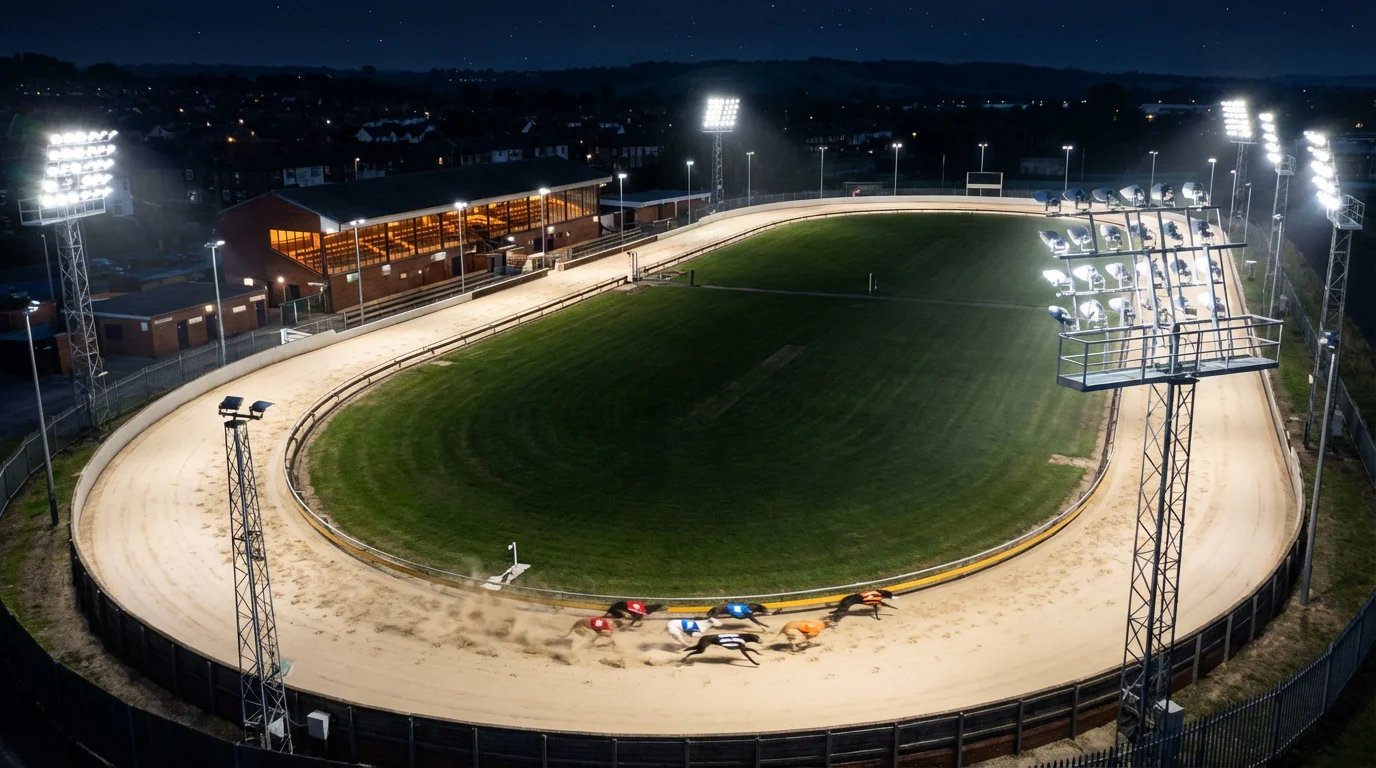
Every UK Track Has Its Own Personality
From tight Romford to wide-open Nottingham, track choice shapes every race. UK greyhound racing operates across a network of licensed venues regulated by the Greyhound Board of Great Britain, each with its own circuit dimensions, surface conditions, bend geometry, and trap biases. A dog that thrives at one track may struggle at another — not because its ability has changed, but because the physical environment demands a different skill set.
For punters, this is a fundamental variable. A finishing time, a form position, or a trap statistic only means something in the context of the track where it was recorded. Knowing which tracks favour inside runners, which produce faster times on dry evenings, and which have bend configurations that punish wide-running dogs is as important as knowing the form of the dogs themselves. It is also, surprisingly, one of the areas where casual bettors do the least homework.
Major GBGB Tracks and Their Characteristics
Each venue has different distances, surfaces, and biases. The following profiles cover the tracks that feature most prominently in the UK racing calendar and are most relevant to punters following dogs through the graded system and into major competitions.
Towcester, in Northamptonshire, is the home of the Greyhound Derby and the most important venue for any serious Derby punter. Its 500-metre sand circuit features a long run to the first bend and bends that punish wide runners. Course form here carries more weight than at any other UK track because every Derby round is run on this course.
Nottingham is one of the UK’s premier greyhound venues, hosting major events including rounds of the St Leger. It is a large, galloping track where wide-running dogs are less disadvantaged than at tighter circuits. The long straights and sweeping bends mean that early pace is important but not quite as decisive as at Towcester — closers with strong finishing speed have a viable route to the win.
Romford, in east London, is a compact, tight-turning track that overwhelmingly favours inside-drawn dogs with quick early pace. The run to the first bend is short, and the bends are tight, which creates significant congestion and interference. Trap 1 has one of the highest win percentages of any trap at any UK track. Dogs that thrive at Romford often struggle at bigger circuits, and vice versa.
Crayford was another London circuit with tight bends and a bias toward early pace and inside draws, but it closed in January 2025. It raced primarily over 380 metres and 540 metres, with the shorter distance sprint events producing particularly predictable trap biases. Crayford form translates less reliably to larger tracks than almost any other UK venue.
Monmore Green in Wolverhampton is a well-regarded track that falls between the extremes of compact Romford and expansive Nottingham. It hosts regular open-class racing and produces competitive fields. The track surface and bend configuration create a relatively balanced trap bias, though Trap 1 still edges ahead statistically.
Sheffield, Sunderland, and Newcastle serve the northern circuit and host regular BAGS and BEGS meetings. Each has its own characteristics — Sheffield’s bends are distinctive, Sunderland produces fast times on its sand surface — but they are less commonly involved in major competition pathways. Dogs moving from these tracks to Towcester for the Derby need assessment against Towcester-specific benchmarks rather than direct time comparisons.
Hove and Brighton on the south coast, Central Park in Kent, and Dunstall Park in Wolverhampton (which replaced Perry Barr in September 2025) complete the regular GBGB circuit. Each venue runs frequent meetings that feed the grading system and produce the form lines that punters use to assess dogs entering bigger competitions. The key for punters is recognising that no two of these tracks produce directly comparable data — a time or form line from one venue must be interpreted in context.
Standard Racing Distances Across UK Tracks
Sprint, middle-distance, and staying races — and why the category matters for betting. UK greyhound tracks offer a range of distances, typically from around 260 metres at the shortest to 900 metres or more for marathon events. The most common categories are sprints (260-300m), standard middle-distance (400-500m), extended middle-distance (540-600m), and staying races (640m and above).
The 480-500 metre range is the heartland of UK greyhound racing and the distance at which the Derby and most major competitions are run. At this distance, the balance between early pace and stamina is roughly equal, producing the most competitive fields and the most uncertain results. Punters specialising in Derby betting will spend most of their time analysing form at this distance.
Sprint races over 260-300 metres are disproportionately influenced by the trap draw and the break from the boxes. There is barely time for a dog to recover from a slow start, which makes early-pace sectionals and trap statistics even more important than at standard distances. The margins between dogs in sprint racing are measured in hundredths of a second, and the favourite strike rate tends to be higher because the reduced distance leaves less room for random events to influence the outcome.
Staying races over 640 metres and beyond test stamina and consistency rather than raw speed. The trap draw matters less because there are more bends and more straight running for dogs to find their position. Staying form is sometimes relevant for Derby analysis, because dogs that have demonstrated stamina in longer races are better equipped to handle the physical demands of a six-round tournament.
Sand vs Other Surfaces — What It Means for Form
Sand is now the standard, but conditions vary track to track. The transition from grass to sand surfaces happened gradually across UK greyhound racing, and today virtually all GBGB-licensed tracks race on sand. However, “sand” is not a single uniform surface. The composition, depth, moisture content, and maintenance regimen differ between venues, producing noticeably different running conditions.
Towcester’s sand is generally considered to produce a slightly slower, heavier running surface compared to some other circuits. Nottingham’s surface tends to produce faster headline times over equivalent distances. Romford and Crayford, with their compact layouts, have different surface management challenges — the bends absorb more pounding because the turning radius is tighter, which can create uneven patches as a meeting progresses.
The practical implication for betting is that surface condition adds a layer of variability to every race. Two dogs with identical recent times from different tracks are not necessarily equally fast. The surface they recorded those times on, the weather at the time, and the track’s maintenance schedule all influence the number. Smart punters learn to think of times as relative to the venue rather than absolute measures of speed.
Irish dogs entering the Derby present a particular challenge. Irish tracks operate under different regulatory standards, and the surfaces — while also predominantly sand — may have different characteristics. A dog that ran 28.80 at Shelbourne Park cannot be directly compared to one that ran 28.80 at Towcester. The conversion isn’t linear, and the only reliable calibration comes from Towcester trial runs before the tournament begins.
Comparing Times Across Different Tracks
A 28.50 at Towcester is not the same as a 28.50 at Nottingham. This is perhaps the single most common analytical error in greyhound betting, and it persists because the numbers look the same on the race card. Without adjusting for track differences, punters consistently overrate dogs with fast raw times from fast tracks and underrate dogs with moderate raw times from slower venues.
The correct approach is to compare each dog’s time to the track average for its grade. If the average open-class 500-metre time at Nottingham is 29.10 and a dog ran 28.50, it is running 0.60 seconds faster than the venue norm. If the average open-class 500-metre time at Towcester is 29.60 and another dog ran 29.20, it is running 0.40 seconds faster than its venue norm. The Nottingham dog has the faster raw time, but the Towcester dog might be the more impressive performer relative to its competition — or it might not, depending on the quality of the fields it raced against. The point is that the comparison becomes meaningful only after the venue context is applied.
Sectional times provide an additional layer of cross-track comparison, particularly the first split. Early-pace data is more transferable between tracks than overall finishing times, because the trap-to-first-bend segment is influenced less by track-specific factors like surface depth and bend radius than the overall race is. A dog that consistently records splits 0.10 seconds faster than the venue average at any track is demonstrably quicker out of the boxes, and that trait is likely to carry over when it moves to a different circuit.
For Derby purposes, the most reliable data is always Towcester-specific. If a dog has raced or trialled at Towcester, use those numbers. If it hasn’t, use relative performance at its home track as a guide, cross-referenced with any available trial data, and accept that the estimate carries more uncertainty than a direct Towcester form read.
Track Literacy Is Betting Literacy
The track isn’t just the venue — it’s a variable in every bet. Each GBGB circuit produces its own data environment, its own biases, and its own competitive dynamics. A punter who treats all tracks as interchangeable is making systematic errors that compound over time, particularly when assessing dogs moving between venues for major competitions.
Building track literacy takes time. It means watching races at different circuits, learning which traps outperform at each venue, understanding how surface conditions change across the seasons, and adjusting your form reads accordingly. None of it is secret information. All of it is available through the GBGB, the Racing Post, and the race results published after every meeting. The edge isn’t in accessing the data — it’s in actually using it.
