

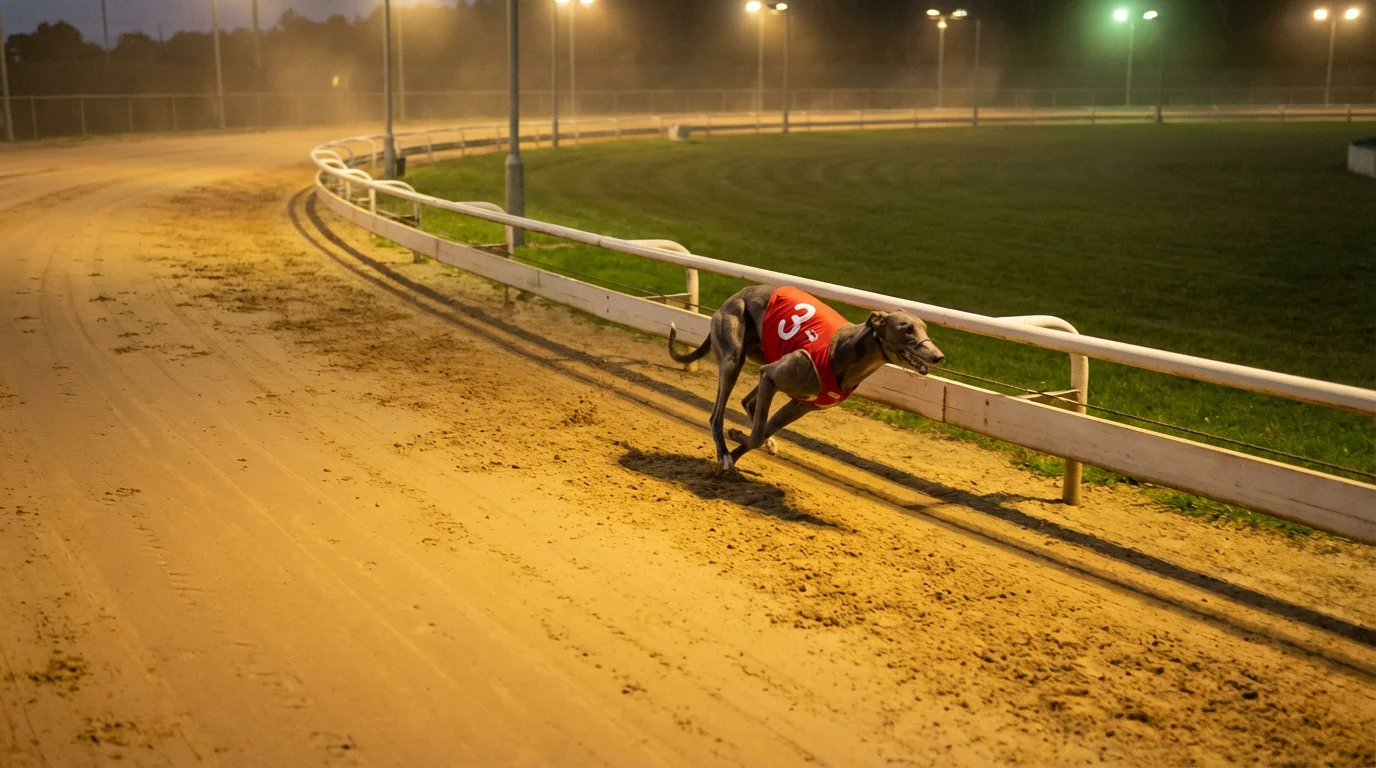
Every Dog Has a Lane — And It Determines What the Draw Means
Railer, middle, wide. Every greyhound has a lane preference — and it determines what the draw means. Two dogs at identical odds, in the same race, from the same grade, can have completely different prospects based on a single factor that most casual punters overlook: where on the track the dog naturally runs. A railer drawn in Trap 1 and a wide runner drawn in Trap 6 are both in their comfort zones. Swap their traps, and neither is the same betting proposition.
Running style is the bridge between the trap draw and the dog’s ability. The draw tells you where the dog starts. The running style tells you where it wants to be. When those two things align, the dog races efficiently, saving ground on the bends and maintaining speed through the straights. When they clash, the dog wastes energy navigating to its preferred position, loses ground, and arrives at the first bend in a worse spot than its raw ability deserves.
Understanding running styles is one of the most efficient analytical upgrades a greyhound punter can make. The information is published on every race card, the patterns are consistent, and the interaction with the trap draw is predictable enough to exploit systematically.
What Are Running Styles?
Running style describes where a dog prefers to position itself on the track — rail, middle, or wide. This isn’t a tactical choice the dog makes consciously. It’s an instinctive behaviour shaped by temperament, physical build, racing experience, and early training. Most greyhounds develop a clear lane preference within their first few races, and that preference remains remarkably stable throughout their career.
Railers hug the inside rail. They break from the traps and immediately seek the shortest path to the first bend, running tight to the rail through every turn. In the form guides, railers are typically designated with abbreviations like “Rls” or “RlsRnUp.” The advantage of railing is geometric: the inside path covers less ground than any other line on the track. A railer that leads into the first bend on the rail gains a positional advantage that compounds through every subsequent turn. The disadvantage is inflexibility. If a railer can’t reach the rail — because it’s drawn wide, because another dog occupies the space, because it breaks slowly — it has no Plan B. Railers out of position tend to lose more ground than other styles because they fight to get back to the rail rather than adapting.
Wide runners do the opposite. They race away from the rail, using the outer part of the track to build and sustain speed through the turns. Form guides note them as “W” or “Wide” or “MidToWide.” Wide running covers more distance — every bend adds extra metres compared to the rail path — but the style suits dogs with sustained pace who need clear running to hit their stride. Wide runners are less vulnerable to congestion at the bends because they’re running in open space. Their risk is different: they give away ground to inside runners on every turn, and they need superior speed or stamina to compensate for the longer route.
Middle runners position themselves between the rail and the outer edge, typically one or two dogs’ width from the inside. They are the most adaptable style — capable of tucking in behind a railer if space allows, or drifting wider if the inside is congested. The form guide abbreviation is usually “Mid.” Middle runners thrive in races where the early pace creates separation, allowing them to slot into gaps rather than fight for a specific line. They struggle when flanked by aggressive breakers on both sides, which can squeeze them into a no-man’s-land where they’re neither on the rail nor wide enough to run freely.
Some dogs show mixed styles depending on the trap draw — railing from Trap 1 but running middle from Trap 3, for example. These adaptive runners are valuable in tournament contexts like the Derby, where trap draws change every round and the ability to produce a competitive run from any position is an advantage that mono-style runners lack.
How Seeding Works
Graded races are seeded. Opens are drawn at random. That distinction changes everything. In standard graded racing at most UK tracks, the racing manager seeds the trap draw based on running style. Railers are placed in the inside traps, wide runners in the outside traps, and middle runners in between. This seeding ensures that dogs start in positions compatible with their natural racing line, producing cleaner races with less interference at the bends.
Seeding is one of the reasons graded racing often appears more formful than open racing. When every dog is drawn in its preferred position, the strongest dog on form is more likely to reproduce its best performance, because the draw isn’t working against its natural style. The results match the form more consistently, and the favourites win at a higher rate than in unseeded events.
Open races — including all Derby heats, semi-finals, and the final — are drawn at random. No consideration is given to running style when allocating traps. This creates the mismatches that generate betting value: a natural railer drawn in Trap 5, a wide runner in Trap 2, two fast-breaking railers drawn side by side in Traps 1 and 2 where only one can hold the rail. These mismatches wouldn’t occur in seeded racing, and they are the primary reason open races — and the Derby in particular — produce more upsets than graded events.
The implications for punters are direct. In graded racing, the trap draw is largely neutral because seeding has already optimised each dog’s position. In open racing, the trap draw is a live variable that can make or break a selection. If you’re transitioning your analysis from standard evening cards to Derby heats, the single biggest adjustment is recognising that the draw is no longer designed to help each dog — it’s random, and the dogs that draw against their style are at a genuine disadvantage that the market doesn’t always price correctly.
Using Running Style in Betting
A railer in Trap 5 is a problem. A wide runner in Trap 1 is a bigger one. The practical application of running-style analysis in betting starts with a single question: does this dog’s draw match its preferred racing line? If yes, you can trust its form figures — the dog will race as it has before. If no, you need to discount its form by a margin that reflects the severity of the mismatch.
The discount isn’t uniform. A railer drawn in Trap 3 is slightly out of position but can still reach the rail within the first few strides if it breaks well. A railer drawn in Trap 6 faces a far more severe problem — it has five dogs between itself and the rail, and the likelihood of reaching its preferred position before the first bend is low. The wider the mismatch, the larger the discount. Some punters apply this intuitively; others use a structured approach, dropping a selection’s estimated chance by a fixed percentage for each trap position away from optimal.
Forecast and tricast bets benefit enormously from running-style analysis. In a six-dog race where you can identify the likely racing lines, the probable first-bend positions become clearer, and the number of realistic finishing-order combinations narrows. A race with two fast railers drawn in Traps 1 and 2 is likely to see those two dogs fight for the lead, with the winner taking the rail and the loser being pushed wide. The dogs in Traps 3 and 4, if they’re middle runners with decent early pace, might slot into the space behind the lead battle. These dynamics are predictable from the card, and they inform exotic bets in ways that pure pace analysis can’t.
The Line That Wins
Running style is the variable most bettors ignore. It shouldn’t be. The information is on the race card, usually in a single abbreviation next to the dog’s name. Reading it takes a second. Applying it — cross-referencing the style with the trap draw and the styles of the neighbouring runners — takes a minute. The edge it provides is consistent and measurable, particularly in open races and tournament events where the draw isn’t seeded.
The Derby’s random draw guarantees that running-style mismatches will occur in every round. Some will be minor — a middle runner in Trap 4 instead of Trap 3. Some will be severe — a committed railer stranded in Trap 6 with no realistic path to the rail. Those severe mismatches create the value. The dogs disadvantaged by the draw will drift in the market, and the dogs favoured by it will shorten. Your job is to assess whether the market’s adjustment is sufficient or whether the mismatch is still underpriced. Running style gives you the vocabulary to make that assessment. Use it.
