

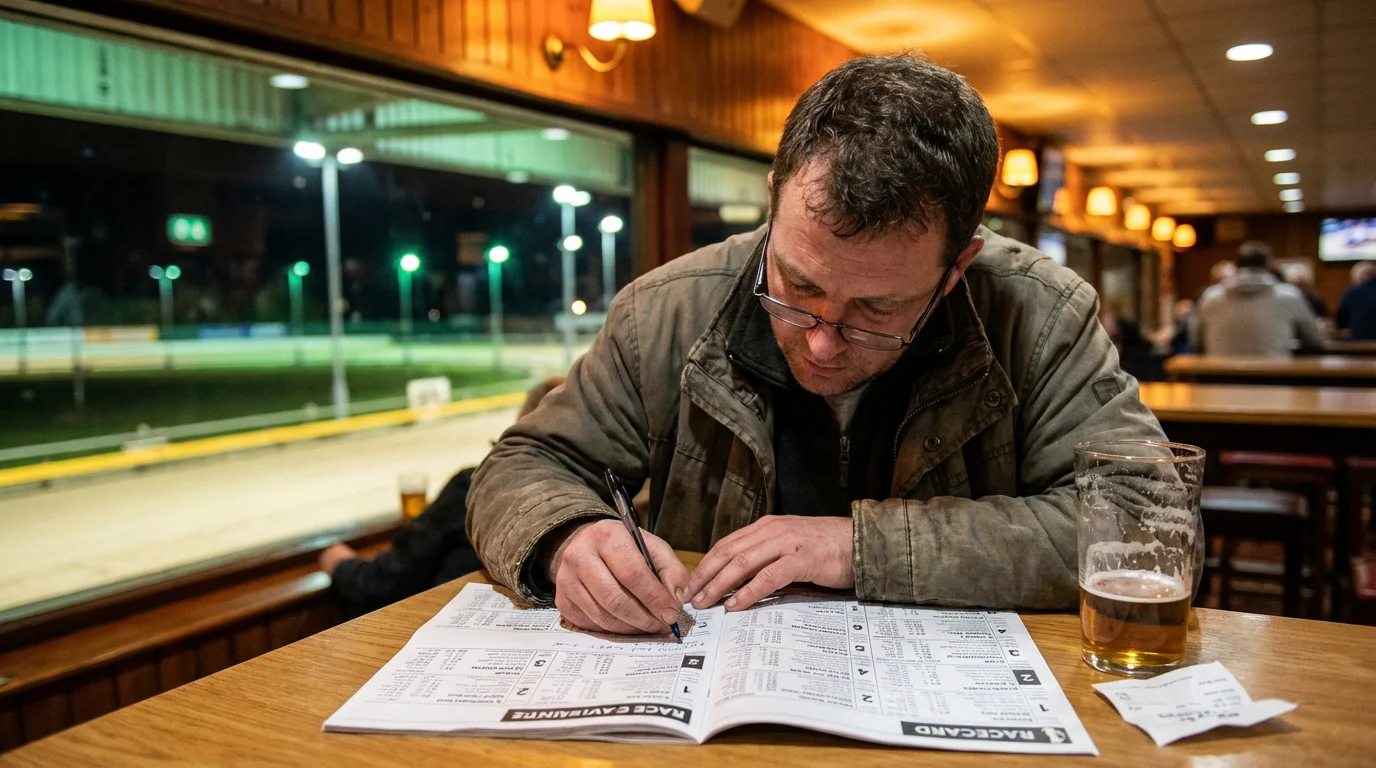
Greyhound betting is faster, tighter and more frequent than horse racing — and most punters never learn to use that to their advantage. On any given evening in Britain, there are dozens of greyhound races across licensed tracks from Romford to Monmore, each offering a six-dog field, a race lasting roughly half a minute, and a betting market that forms and settles in the time it takes to drink a cup of tea. The volume of opportunity is staggering. The question is whether you know how to navigate it.
This guide is built for UK-based bettors who want to understand greyhound racing from the ground up — not from a position of vague familiarity, but with the kind of structural knowledge that turns an evening’s entertainment into something more deliberate. Greyhound betting has its own vocabulary, its own market quirks and its own data ecosystem. It shares some mechanics with horse racing — win bets, each-way terms, starting prices — but the differences are more significant than the similarities. Six runners instead of a dozen or more. No jockeys making tactical decisions mid-race. A trap draw that can decide the result before the hare even moves. These distinctions matter, and understanding them is the first step towards making decisions rather than guesses.
The UK greyhound racing circuit operates through the Greyhound Board of Great Britain, which licenses tracks, registers dogs and publishes the results data that every serious bettor relies on. There are currently eighteen GBGB-licensed stadiums running regular fixtures, split between evening meetings — known as BEGS (British Evening Greyhound Service) — and afternoon sessions under the BAGS (Bookmakers’ Afternoon Greyhound Service) umbrella. The distinction matters for betting because BAGS meetings typically feature more competitive fields and deeper form data, while BEGS meetings can include weaker cards where the market is thinner and the value harder to assess.
Whether you’re placing your first greyhound bet or looking to sharpen an approach that hasn’t been delivering, the structure is the same: understand the racing format, learn the bet types, read the racecard, apply a basic filtering strategy, and choose a platform that offers the features you need. None of these steps require expertise. All of them require attention. The sport rewards observation more than instinct, and the punters who do best over time are the ones who treat the data seriously and keep the emotional bets to a minimum.
How Greyhound Racing Betting Works
Six dogs. One trap each. Roughly thirty seconds to settle everything. That’s the basic structure of a greyhound race in Britain, and it defines the betting proposition in ways that are fundamentally different from other sports. There’s no half-time, no tactical substitution, no weather delay. The traps open, the dogs run, and within half a minute you know whether your assessment was right or wrong. The speed of resolution is both the appeal and the challenge: it encourages rapid-fire betting, which is precisely the habit you need to resist if you want to bet profitably.
Every licensed UK greyhound race features six dogs, each assigned a trap numbered 1 through 6. The traps are mechanically operated boxes aligned in a row at the start line. When the mechanical hare passes the traps, the lids spring open simultaneously, and the dogs break towards the first bend. The starting position — the trap draw — is not random in the way that a coin toss is random. It’s assigned by the racing manager based on the dog’s running style, previous form and, in graded racing, its competition level. In open races and major events like the Greyhound Derby, the draw is made by ballot after each round, which introduces a genuine element of chance into the competition’s structure.
Understanding Trap Colours and Draw
Each trap corresponds to a coloured racing jacket that the dog wears during the race. The colours are standardised across all UK tracks: Trap 1 is red, Trap 2 is blue, Trap 3 is white, Trap 4 is black, Trap 5 is orange and Trap 6 is black with white stripes. These colours exist purely for identification — they have no intrinsic significance — but they become second nature to regular bettors, who will instinctively track “the red jacket” or “the blue” during a race rather than trying to read the dog’s name on a small vest at thirty miles per hour.
The trap draw matters because it determines the dog’s starting position relative to the inside rail and, crucially, to the first bend. Inside traps — 1 and 2 — give the dog a shorter route to the bend, which is an advantage for dogs that break quickly and run close to the rail. Outside traps — 5 and 6 — force the dog to cover more ground to reach racing position but offer the benefit of cleaner running away from the early-bend traffic. The middle traps — 3 and 4 — are the most neutral, but they’re also the most vulnerable to being squeezed on both sides as the field converges.
Trap bias varies significantly by track. At tight circuits like Romford, the inside traps dominate statistically. At wider, more galloping tracks like Nottingham, the bias is less pronounced. At Towcester, the Derby venue, the relatively long run to the first bend moderates the inside advantage, but the data still shows a slight edge for traps 1 and 2 over a large sample. Any serious greyhound bettor should know the trap bias data for the tracks they bet on — it’s publicly available through GBGB results, and ignoring it means ignoring a free variable.
How Greyhound Odds Are Set
Greyhound odds are compiled by bookmakers using a combination of form data, trial times, trap draw information and market positioning. The process starts with a “tissue” — an internal first-draft pricing — created by a compiler who assigns an implied probability to each dog. These probabilities deliberately sum to more than 100%, and the excess is the overround: the bookmaker’s built-in margin. In a typical six-dog greyhound race, the overround sits between 115% and 120%, meaning the bookmaker expects to retain 15-20% of the total pool regardless of the result.
For most UK greyhound races, the starting price — the odds at the moment the traps open — is determined by on-course bookmakers and then applied as the settlement price for bets placed at SP. Many online bookmakers also offer early prices, available from an hour or more before the race, which can differ from the eventual SP. The difference between these two prices is where alert bettors find edge: if you have information or analysis that the market hasn’t yet incorporated — an improving trial, a favourable trap for a particular dog’s running style — taking the early price can lock in value before the market adjusts.
Best Odds Guaranteed, offered by most major UK bookmakers on BAGS races and selected BEGS meetings, removes part of this dilemma. Under BOG, if you take an early price and the SP drifts higher, you’re paid at the SP. If the SP shortens below your taken price, you keep your original odds. It’s a one-directional safety net, and its availability on greyhound racing is one of the genuine advantages the sport offers over other betting markets. Always check whether BOG applies before placing an early-price bet.
Greyhound Bet Types Explained
Win is where you start. Forecast is where it gets interesting. The range of bet types available on a standard UK greyhound race is wider than most newcomers expect, and each type carries different risk-reward characteristics that suit different situations. Understanding what each bet does — and when it makes sense to use it — is more important than any individual selection decision.
Win, Place and Each Way
A win bet is the simplest proposition in greyhound racing: pick the dog that crosses the line first. Your stake multiplied by the odds, plus the stake returned, gives you the payout. If the dog finishes second or worse, you lose the stake. In a six-dog field, the theoretical probability of any single dog winning — if all were equal — is 16.7%. Obviously, they’re not equal, which is why the odds vary. But that baseline number is useful: it reminds you how difficult it is to consistently pick winners in a sport with a small field and tight margins.
Place betting on greyhounds works differently from horse racing. In a standard six-runner greyhound race, bookmakers typically pay two places at reduced odds — usually 1/4 of the win odds. Some bookmakers occasionally extend this to three places for specific promotions, but the standard UK terms are two places. A place bet is a standalone wager on the dog finishing first or second, paid at the place fraction of the advertised odds.
Each way combines both: your stake is split in two — half on the win, half on the place. If the dog wins, both parts pay. If it finishes second, the win part loses and the place part returns at 1/4 odds. If it finishes third or worse, everything loses. Each way is valuable when you believe a dog has a strong chance of finishing in the first two but isn’t the outright favourite. At a price of 5/1 or longer, the place element of an each-way bet offers a reasonable return on its own. At shorter prices — 2/1 or less — the place return is so small that each-way rarely justifies the doubled stake.
Forecast, Tricast and Combination Bets
Forecast bets require you to predict the first two dogs to finish, in the correct order. A straight forecast names dog A to win and dog B to finish second — get the order wrong and the bet loses, even if both dogs fill the first two places. Returns are calculated using the Computer Straight Forecast formula, which is based on the starting prices of both dogs, and the dividends can be substantial. A forecast involving two mid-priced dogs regularly pays 20/1, 40/1 or higher.
A reverse forecast covers both possible orders — A first and B second, or B first and A second — for double the stake. This halves your risk of getting the order wrong but also halves the effective return per unit staked. For a six-dog race where you’ve identified two likely contenders without a strong view on which will finish ahead, the reverse forecast is a practical compromise.
Tricast bets extend the principle to the first three finishers in exact order. The payouts are significantly larger — Computer Tricast dividends in greyhound racing routinely run into triple figures — but the difficulty of predicting three finishing positions correctly makes this a high-variance bet. Combination tricasts, which cover all possible orderings of your three selected dogs, require six units of stake but guarantee a return if all three finish in the top three in any order. In a six-dog race, where you’re trying to identify three of six runners, the hit rate on combination tricasts is higher than in larger fields, which makes greyhound racing a particularly attractive sport for this bet type.
Accumulator and Trap Challenge Bets
Accumulator bets chain multiple selections across different races into a single wager, with the winnings from each leg rolling into the stake for the next. A double combines two selections; a treble combines three; four or more selections form an accumulator. The appeal is obvious — the compounding effect produces large potential returns from small stakes. The problem is equally obvious: every leg must win for the bet to pay. One loser kills everything.
In greyhound racing, where meetings run six or more races per evening, accumulators are popular and heavily promoted by bookmakers. The maths, however, is hostile. If each of your four selections has a 33% chance of winning — roughly the strike rate of well-selected favourites — the combined probability of all four winning is approximately 1.2%. That’s a hit rate that requires extraordinary patience or extraordinary luck to survive. Doubles and trebles, with their lower leg counts, offer a more realistic proposition. Beyond four legs, you’re essentially buying a lottery ticket.
Trap challenge bets are a greyhound-specific format offered by some bookmakers, typically requiring you to pick the winner of every race on a card from a specific trap number. The returns can be huge, but the difficulty is immense — you’re relying on a single trap position to produce winners across multiple races with different competitive dynamics. Treat these as entertainment, not strategy.
Reading the Greyhound Racecard
Every line on the card is a compressed story — speed, position, trouble. The greyhound racecard is the single most important document available to bettors, and reading it properly separates informed decisions from guesswork. UK racecards follow a standardised format across all GBGB-licensed tracks, presenting a dense but logical set of data points for each dog in the race.
At the top level, each entry shows the dog’s name, its trap number and jacket colour, the trainer’s name, and the dog’s weight. Weight fluctuations between races are worth noting — a significant drop can indicate fitness issues, while a gradual increase might suggest a dog maturing into peak condition. Below these basics, the form line appears: a sequence of numbers representing the dog’s finishing position in its most recent races, read from left to right as oldest to most recent. A form line of “111321” tells you the dog has won three of its last six races, finished third once and second once — a solid recent record that suggests competitive consistency.
Alongside the form figures, most racecards include abbreviated race comments that describe how the dog ran. These abbreviations are standardised: “SAw” means slow away from the traps, “Crd” means the dog was crowded or impeded, “Led” or “Ld” indicates the dog led at some point during the race, “RnUp” means it raced prominently without leading, and “Fin” followed by a number notes the finishing distance behind the winner. These comments transform a bare finishing position into a narrative. A dog that finished third with the comment “SAw, Crd1, RnOn” — slow away, crowded at the first bend, ran on — is a fundamentally different proposition from one that finished third with “Ld-3, Fdd” — led until the third bend, then faded.
Timing data is the next layer. The racecard shows the dog’s finishing time for each recent race, measured in seconds over the relevant distance. More useful than the raw time is the sectional data — the split between the trap-to-first-bend time (early pace) and the first-bend-to-finish time (run-home). Early-pace sectionals tell you how quickly the dog breaks from the trap and reaches racing position. Run-home times tell you whether the dog sustains its speed or fades in the closing stages. A dog with a fast early sectional but a slow run-home is a front-runner that wilts under pressure. A dog with moderate early pace but a fast run-home is a closer that finishes strongly if it avoids early trouble.
The grade column indicates the competitive level. UK greyhound racing uses an alphanumeric grading system — A1 is the highest standard in graded racing, with the number increasing as the level drops. Open races sit above the grading system entirely and feature the best dogs at a given track. A dog dropping in grade — from A2 to A3, for example — is racing against weaker opposition and should be expected to compete more strongly, all else being equal. A dog rising in grade faces a sterner test. Grade changes are one of the most reliable signals on the racecard, and they’re frequently underweighted by casual bettors who focus solely on recent form figures.
Finally, the racecard shows the dog’s best time at the relevant track and distance. This number provides a ceiling: it tells you what the dog is capable of on its best day, under ideal conditions. The gap between a dog’s best time and its recent average times is a measure of consistency. A dog whose best time is 28.40 but whose last three runs were 28.90, 29.10 and 28.85 is either inconsistent or declining. A dog whose best time and recent times are tightly clustered — say, 28.50, 28.55, 28.60 — is a reliable performer whose racecard data you can trust.
Five Strategies That Improve Your Strike Rate
Strategy isn’t a system. It’s a set of filters that remove bad bets. The difference between a losing greyhound bettor and a breaking-even one is rarely the quality of their selections — it’s the number of bad bets they don’t place. Every race card presents six dogs, and the temptation is to find something to back in every race. Discipline means walking past the races where you don’t have an edge and concentrating your stakes where you do.
The first filter is track knowledge. Greyhound form is track-specific to a degree that horse racing form is not. A dog that posts fast times at Romford — a tight, flat track that rewards inside-trap speed — may struggle at Towcester, where the wider bends and longer straights demand a different physical profile. Before betting on any race, confirm that the dog’s recent form was recorded at the same track, or at a venue with comparable characteristics. Cross-track form comparisons are unreliable unless you adjust for the specific differences in circuit geometry and surface speed. If you don’t know those differences, you don’t have an edge — so don’t bet.
The second filter is trap draw awareness. As outlined earlier, trap bias is a measurable phenomenon at every UK track. Before staking on any selection, check whether the dog’s assigned trap aligns with its running style. A confirmed railer — a dog that runs best against the inside rail — drawn in Trap 5 faces a structural disadvantage that its form figures alone won’t reveal. Conversely, a wide runner drawn in Trap 1 will be forced into an unnatural racing line. The dogs that win most consistently are those whose natural running style matches their trap draw on the day. When the two are mismatched, reduce your confidence and your stake accordingly.
The third filter is trainer form. In greyhound racing, the trainer’s current performance is a more reliable indicator than in most sports. A trainer whose dogs have been winning frequently across recent meetings is running a kennel in good form — the dogs are fit, well-fed, well-exercised and well-prepared. Trainer strike rates are published in the GBGB results data and on most form analysis services. A trainer running at a 25% win rate over the past month is producing better-than-average results; one running at 8% is struggling. Factor this into your assessments, particularly in graded racing where the competitive margins are tight.
The fourth filter is race type selection. Not all greyhound races offer equal betting value. Open-class races, where the strongest dogs compete, produce the most reliable form data and the most efficient markets — which means the odds are harder to beat but your assessments are more likely to be accurate. Lower-grade races — A6, A7, and below — feature less predictable dogs, thinner form data and wider market margins. The value in lower grades exists, but it requires more specific track knowledge to identify. If you’re building a betting approach from scratch, start with open-class and upper-grade races where the data quality supports better decisions.
The fifth filter is staking discipline. This is not a selection strategy — it’s a survival strategy. Set a fixed betting bank separate from your personal finances. Use level stakes or a proportional staking method that risks a consistent percentage of your bank on each bet — typically 2-5%. Never increase your stake after a loss to chase back what you’ve lost. The impulse to do so is powerful and universal, and it is the single most common reason casual greyhound bettors move from modest losses to serious ones. The maths is straightforward: if you chase a £10 loss with a £20 bet and that loses too, you’re £30 down instead of £10. The next race doesn’t know about the last one. Neither should your stake.
These five filters — track knowledge, trap draw, trainer form, race selection and staking discipline — won’t turn you into a profitable bettor overnight. What they will do is eliminate the category of bets that have no rational basis. Every bet you don’t place on a race you don’t understand is money saved, and in a sport where the margins are genuinely thin, the bets you avoid matter as much as the ones you make.
Where to Bet on Greyhounds Online
The platform matters less than the features it offers. All major UK-licensed bookmakers accept bets on greyhound racing, and the core experience — selecting a dog, placing a stake, receiving a payout — is functionally identical across them. Where they differ is in the features that affect your long-term profitability: odds quality, Best Odds Guaranteed availability, live streaming, and the depth of racecard information provided.
Best Odds Guaranteed is the single most important feature to look for. Not all bookmakers offer BOG on all greyhound meetings. Some restrict it to BAGS races, others extend it to BEGS evening fixtures, and a few apply it across the board. Having a funded account at a bookmaker that offers BOG on your preferred racing circuit means you can take early prices without risk of missing a drift — the one scenario where taking a price early is a pure advantage.
Live streaming is the second priority. Watching the races you bet on — rather than relying on results alone — provides information that no racecard can capture. You see how a dog breaks from the trap, how it handles the bends, how it responds when crowded, and whether its finishing effort was full or held in reserve. Several major bookmakers stream UK greyhound racing live to customers with a funded account or a placed bet on the meeting. The quality varies, but even a basic stream is more informative than a set of form figures. If you’re serious about greyhound betting, watch as many races as you can at the tracks you bet on.
Racecard depth varies surprisingly between platforms. Some bookmakers provide minimal information — dog name, trap, recent form — while others include sectional times, race comments, trainer statistics and track-specific performance data. The bookmakers with the most detailed racecards tend to attract more informed bettors, which can make their markets more competitive. For a beginner, this is actually an advantage: a more efficient market is harder to beat, but the information available to you is better, which accelerates your learning curve.
A practical approach is to maintain funded accounts at two or three bookmakers. This allows you to compare odds before placing a bet — a practice called “shopping the line” in professional betting circles. The price difference on the same dog between two bookmakers can be significant: a dog at 4/1 with one firm and 9/2 with another represents a 12.5% difference in potential return. Over hundreds of bets, consistently taking the best available price compounds into a meaningful advantage. It’s the easiest edge in greyhound betting, and it requires nothing more than a few extra seconds of comparison before you click “place bet.”
All UK bookmakers accepting greyhound bets must hold a licence from the UK Gambling Commission. This provides regulatory protection including access to dispute resolution, self-exclusion tools and deposit limits. Before opening any account, familiarise yourself with the responsible gambling tools available — particularly deposit limits and loss limits, which can be set in advance and are the simplest way to keep recreational betting within comfortable boundaries.
Sharper Eyes, Smarter Slips
You won’t win every bet. But you’ll stop making the same losing ones. That shift — from undisciplined punting to structured decision-making — is the real difference this guide is designed to support. Greyhound betting doesn’t require insider knowledge or mathematical genius. It requires a willingness to engage with the data the sport publishes freely, to understand the mechanics of the market, and to accept that the best bet on any given card is sometimes no bet at all.
The tools are available to everyone. GBGB publishes results, times and racecards for every licensed meeting. Bookmakers offer live streaming, often at no additional cost beyond a funded account. Form analysis services aggregate the data into formats that are easy to interpret. The barrier to informed greyhound betting is not access — it’s effort. The punters who lose consistently are, overwhelmingly, the ones who place bets without reading the racecard, without checking the trap bias, without knowing the trainer’s recent form. They’re betting on instinct in a sport that rewards analysis.
Start with small stakes on races you’ve properly assessed. Keep a record of your bets — selection, odds taken, result, profit or loss. Review that record weekly. You’ll see patterns emerge: bet types that suit your judgement, tracks where your assessments are more accurate, situations where you consistently lose. The record is a mirror. It shows you what you’re actually doing, as opposed to what you think you’re doing, and that distinction is where improvement begins.
Greyhound racing in Britain runs almost every day of the year. There is no shortage of opportunity. The temptation, particularly for new bettors, is to bet too often on too many races with too little analysis. Resist it. The sport will still be there tomorrow evening, and the meeting after that, and the one after that. Your bankroll needs to last long enough for your skill to develop, and it won’t if you’re staking on every race from the first trap to the last.
The fastest way to improve is to watch. Watch races at the tracks you plan to bet on. Watch how dogs from different traps negotiate the first bend. Watch which running styles produce winners on which circuits. Watch the dogs that the racecard says should win and notice when they don’t — and try to understand why. The racecard tells you what happened in past races. Your eyes tell you what’s happening now. The combination of the two is the closest thing to an edge that any punter can develop, and it costs nothing more than your time and attention.
