

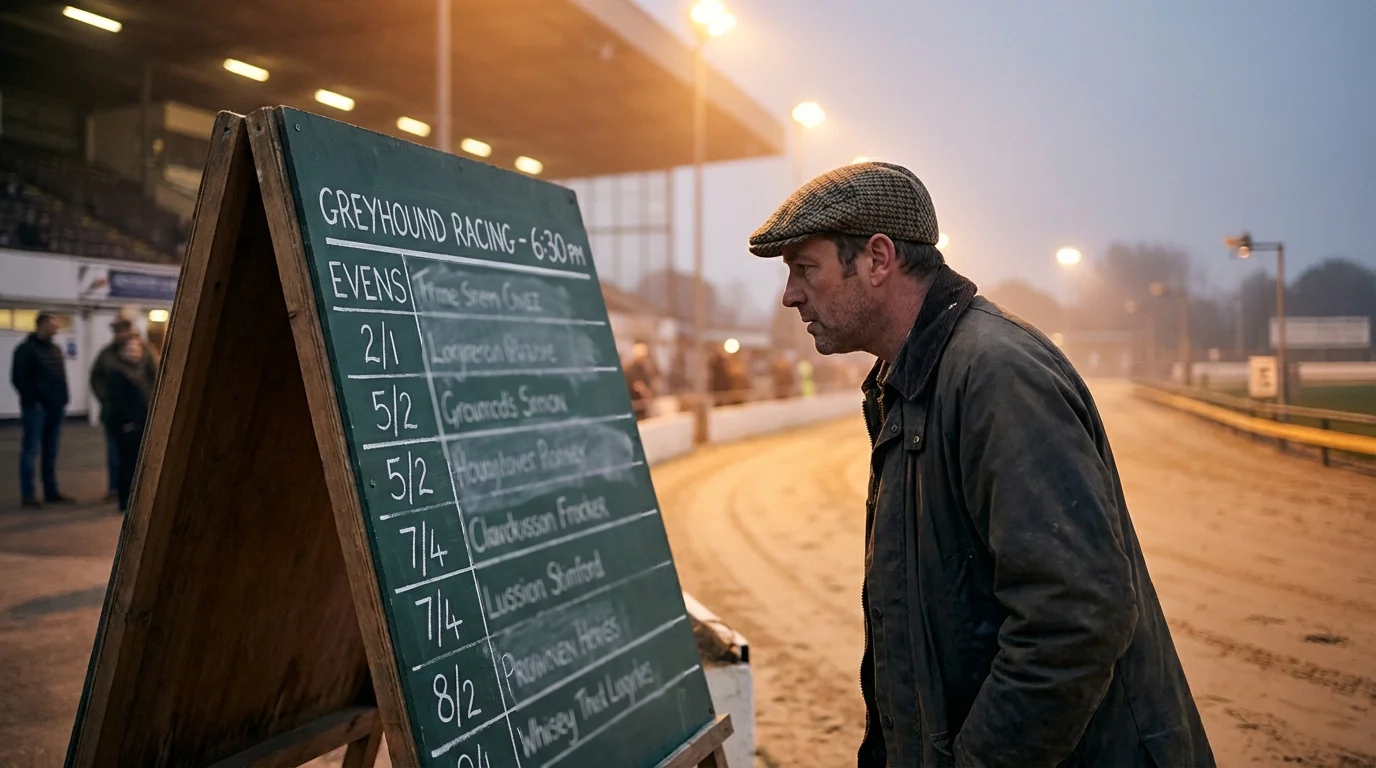
Ante-Post Odds Open Months Before the First Heat
The Derby ante-post market is the longest-running bet in UK dog racing. While most greyhound wagers are placed minutes before a race, ante-post odds on the English Greyhound Derby appear weeks — sometimes months — before the first heat is even scheduled. Bookmakers open their outright winner markets once the entry list firms up, and from that moment, prices begin to shift in response to trial reports, kennel news, and the volume of money landing on individual dogs.
For casual punters, this feels premature. The heats haven’t run. The trap draws haven’t been made. Injuries haven’t happened yet. But that uncertainty is precisely the point. Ante-post betting exists because the market doesn’t know what’s going to happen, and it compensates for that ignorance with longer odds than you will ever see once the competition begins. A dog priced at 33/1 in the ante-post book might be 5/1 by the semi-finals if it runs well through the rounds. The price you take early reflects the risk you’re absorbing — and the reward for being right before everyone else.
This guide covers how ante-post odds on the Greyhound Derby work mechanically, where value tends to hide in these markets, the specific risks you’re accepting when you bet without a race to watch, and the timing windows that matter most. If you’ve ever looked at an outright Derby market and wondered whether the prices mean anything useful, they do. You just need to know how to read them.
How Ante-Post Greyhound Odds Work
No refund if your dog doesn’t run. That’s the trade-off for longer odds. Every ante-post bet on the Greyhound Derby operates under this fundamental rule, and it shapes everything about how the market is built.
When bookmakers compile their ante-post tissue for the Derby, they’re pricing probability across a field that can include over 180 entries. The process starts with a rough ranking based on known form — open-race performances, trial times at Towcester, trainer reputation, and recent competition history. Dogs from leading kennels like those of Graham Holland or Liam Dowling will typically sit near the top of the market, not because they’re guaranteed to reach the final, but because the probability of them progressing through multiple rounds is higher than it is for a lightly raced A2 dog from a smaller operation.
The overround on an ante-post Derby book is substantial. With dozens of entries priced, the combined implied probability routinely exceeds 150%, sometimes more. That margin is the bookmaker’s cushion against the volatility of a multi-round knockout event. It also means that raw implied probability calculations will overstate each dog’s chance of winning. A dog priced at 10/1 implies roughly 9.1% in a fair market, but in a Derby ante-post book with a 160% overround, the true implied chance is closer to 5.7%. This matters when you’re assessing whether a price represents value.
Odds move in response to two forces: money and information. If a well-known punter or syndicate backs a dog heavily, the price shortens regardless of any on-track developments. Conversely, a strong trial time reported in the trade press or a favourable veterinary update can trigger a wave of bets that compresses the price within hours. The ante-post market is thin by horse racing standards — fewer bookmakers, smaller limits, less liquidity — so prices can move sharply on relatively modest volumes. A few hundred pounds on a 40/1 shot in the morning can turn it into a 25/1 shot by the afternoon.
One mechanical detail that catches newcomers: ante-post Derby odds are almost always offered in fractional format by UK bookmakers, reflecting the sport’s traditional pricing conventions. Decimal odds are available on most platforms if you switch your settings, but the market itself is quoted fractionally. Understanding both formats is essential if you’re comparing prices across multiple books.
Where to Find Ante-Post Value
Trainers with multiple entries give you more shots at a price. This is one of the most reliable structural edges in the Derby ante-post market. A kennel that qualifies four or five dogs for the opening round spreads its chances across the tournament draw, and if one of those dogs is unfancied in the early markets while its kennel companion sits at the top, the overlooked entry can represent significant value.
The reasoning is straightforward. Top kennels don’t enter weak dogs in the Derby. Every entry costs money, requires preparation, and occupies a training slot. If a leading Irish trainer enters five dogs, all five have been assessed internally as genuine Derby contenders. The market, however, tends to focus its attention — and its money — on one or two from each leading kennel. The others drift to longer prices not because they lack ability, but because the betting public gravitates toward the name they recognise or the dog with the flashiest recent form line.
Trial times are another underexploited source of ante-post value. Before the Derby begins, most serious entries will run at least one timed trial at Towcester. These times are published in the racing press and on specialist sites, but they’re not always reflected in the ante-post odds quickly. A dog that clocks an impressive trial sectional on a Tuesday morning might not see its ante-post price adjust until Wednesday evening, or later. If you’re tracking trial reports in real time — via Racing Post Greyhound, the GBGB results service, or social media feeds from trainers — you can act before the market catches up.
Course form deserves particular attention. Dogs that have raced at Towcester before and handled its specific characteristics — the sand surface, the long run to the first bend, the configuration of the third and fourth turns — carry an advantage that doesn’t always show up in the headline form figures. A dog with two wins at Towcester from three starts is a different proposition to one with identical times recorded exclusively at Nottingham or Romford.
Risks of Ante-Post Betting on Greyhounds
Injury, retirement, and form collapse are all priced into the odds — partially. The ante-post market accounts for the general risk that some dogs won’t make it to the final, but it cannot price the specific risk that your dog will be the one to pull up lame in Round 3. That asymmetry is the core gamble of ante-post betting.
Greyhounds are fragile athletes. A muscular injury sustained in a Tuesday night open race at Shelbourne can end a Derby campaign overnight, and there’s no insurance mechanism in the bet. Unlike horse racing, where non-runner policies on certain ante-post markets have become more common, greyhound ante-post bets are almost universally settled as losers if the dog is withdrawn at any stage before the final. Some bookmakers may offer “final night only” markets with non-runner rules, but these are rare and carry shorter prices to compensate.
Form collapse is subtler and harder to predict. A dog that looked exceptional in trials might arrive at the first round in different condition — slightly heavier, slightly slower out of the boxes, or simply not running with the same intensity. Greyhound form is volatile at the individual level. A dog’s best five runs might be separated by performances that would struggle in lower grades. The ante-post punter is betting on the ceiling, while the risk is that the dog delivers its floor.
There’s also the structural risk of unfavourable trap draws. The Derby draw is made after each round, and a dog that needs Trap 1 to show its best form might find itself in Trap 6 for a critical quarter-final heat. This alone can end a campaign without any physical issue. The market doesn’t — and can’t — price future trap allocations, so every ante-post bet carries an implicit assumption that the draw won’t sabotage your selection.
Best Time to Take a Greyhound Derby Ante-Post Bet
Too early and you’re guessing. Too late and the value’s gone. The optimal timing for a Derby ante-post bet falls into one of three windows, each with a different risk-reward profile.
The first window opens when the ante-post book is initially published, usually several weeks before the opening heats. Prices at this stage are at their longest, but your information is at its thinnest. You’re relying on general form assessment, kennel reputation, and whatever trial data has been made public. This is the window for punters who have strong views on specific dogs — typically those who follow the sport closely year-round and have already identified their Derby fancies from open-race form in the preceding months. If you don’t have that depth of knowledge, betting at this stage is essentially a lottery with slightly better odds.
The second window comes immediately after the Round 1 heats. This is when the market adjusts most dramatically. Dogs that win their heats impressively see their prices cut, sometimes by half. Dogs that qualify as fastest losers or scrape through in third might drift. The critical move here is to identify Round 1 winners whose performances were even better than the market adjustment suggests — a dog that won by six lengths in a fast time but whose price only shortened from 20/1 to 14/1, for instance, might still represent value if the performance indicated genuine Derby-winning class.
The third window is the post-semi-final period, in the hours between the semi-final results and the final-night book opening. By this point, you know the six finalists, their trap draws, and their most recent Towcester form. The odds are much shorter, but the uncertainty is vastly reduced. Value at this stage comes from disagreeing with the market’s assessment of the draw — backing a dog that the market has pushed out because of a wide trap, for example, if its running style suits the outside.
Between these windows, the market tends to be relatively static. Prices drift or shorten gradually based on rumour and reported training updates, but the big moves cluster around actual race results. Patience between windows is as important as conviction within them.
Early Bets, Long Memories
The best ante-post punters keep notes, track trials, and move first. They don’t wait for the Racing Post headline to tell them a dog is live — by then, the price has already moved. They maintain a shortlist of dogs from leading kennels throughout the spring, cross-reference trial times against previous Derby winners’ profiles, and have a clear idea of what price they want before the book even opens.
Ante-post betting on the Greyhound Derby is not for everyone. The timescales are long, the risks are real, and the majority of bets will lose simply because most dogs don’t win the Derby. But for punters willing to do the preparatory work, the ante-post market is where the Derby pays its best prices. The information advantage doesn’t come from inside knowledge or algorithms. It comes from paying attention earlier and more carefully than the rest of the market. In a sport where the public betting pool is small and concentrated, that kind of diligence still moves the needle.
