

Why Finishing Time Alone Is Misleading
A fast time on a fast track means nothing without context. This is the fundamental problem with using finishing times as the primary form metric in greyhound racing, and it’s a problem that sectional analysis solves.
Two dogs can both run 29.50 over 500 metres at Towcester and be completely different racing propositions. One might have broken fast, led by three lengths at the second bend, and faded in the home straight, just holding on. The other might have been crowded at the first turn, sat fourth through the middle of the race, and powered home with the strongest closing split in the field. The finishing time is identical. The form stories are opposite. One dog is a pace-dependent front runner who needs a clear break. The other is a closer with tactical flexibility and stamina reserves. Betting on them requires different assessments, different conditions, and different prices.
Sectional times break the race into segments that reveal how it was actually run, not just how long it took. For any punter moving beyond casual betting into serious greyhound form analysis, sectionals are not optional. They’re the difference between reading a result and understanding a performance.
What Sectional Times Are and How They’re Measured
Sectionals split a race into segments — usually trap-to-first-bend and first-bend-to-finish. The exact measurement points vary by track, but the principle is consistent across UK greyhound racing: electronic timing equipment records the time at which each dog passes specific points on the circuit, producing a breakdown of the overall race time into component parts.
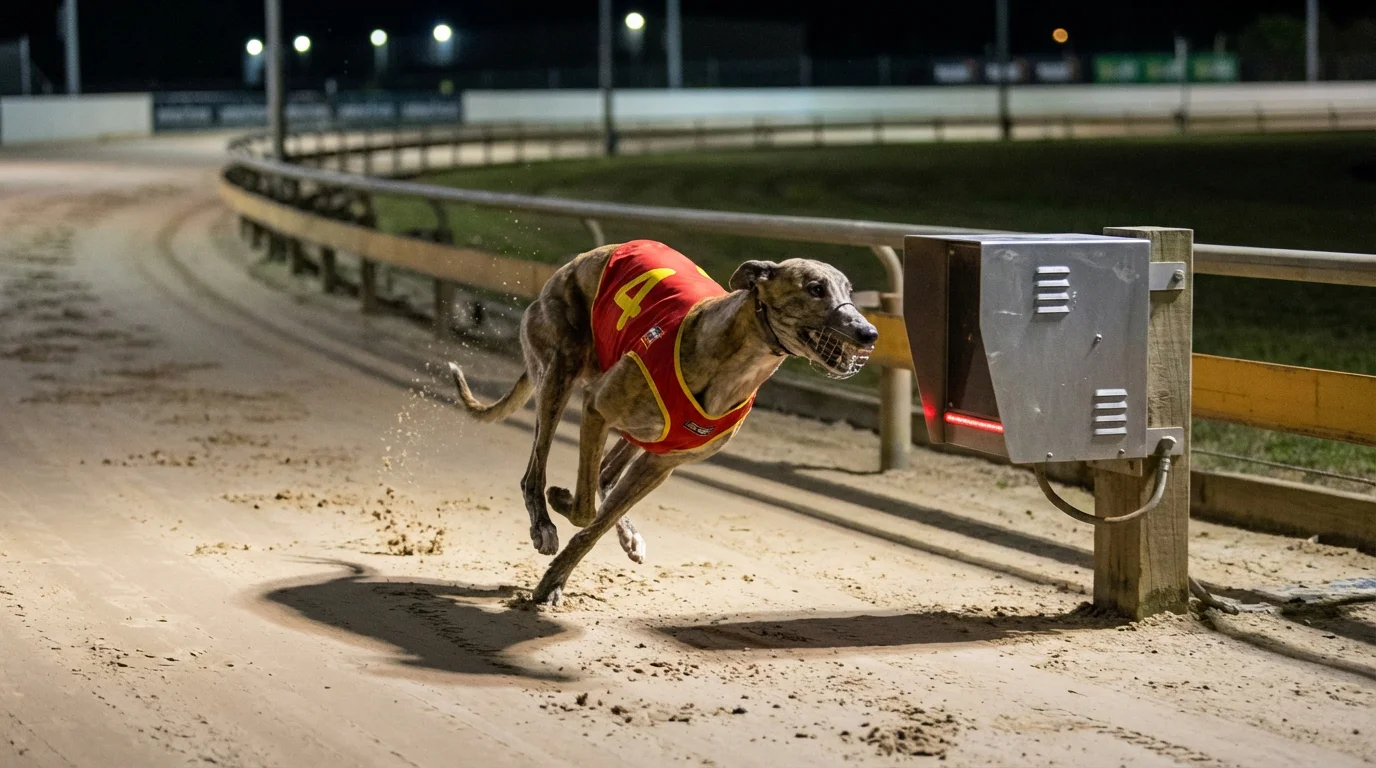
The most common sectional in UK racing is the “split” or “first sectional,” which measures the time from the traps opening to the dog reaching the first timing beam, typically positioned shortly after the first bend. This split captures the break from the boxes, the initial sprint, and the negotiation of the first turn — the phase of the race that most strongly predicts the final result. A second sectional, often called the “run-home,” covers the remaining distance from that first timing beam to the finishing line.
At Towcester, the split is taken at a point after the first bend on the 500-metre course. A typical first sectional for a competitive open-class dog at this distance is in the region of 4.50 to 4.70 seconds, with faster splits indicating quicker early pace. The run-home time covers the remaining approximately 250 metres of the race. These numbers are published in race results on the GBGB website, in the Racing Post greyhound section, and on specialist data platforms.
Some tracks also record an intermediate sectional — a third timing point between the first split and the finish — but this is less common and not universally available. For most analytical purposes, the two-part split (early pace and run-home) provides sufficient granularity to assess a dog’s racing profile. More data would be better, but the existing two-point system already offers far more insight than the raw finishing time alone.
One technical note: sectional times are measured to hundredths of a second. The difference between a 4.52 and a 4.58 first split is six hundredths — a gap that sounds trivial but translates to approximately half a length at the first bend. In a sport where races are routinely decided by a length or less, these margins matter.
Early Pace — The Single Most Important Number
Dogs that break fast dominate greyhound racing. The sectional proves it. Across all UK tracks and all distances, the dog that records the fastest first split wins the race more often than any other single metric would predict. This isn’t a subtle tendency — it’s the defining statistical pattern of the sport.
The reason is mechanical. Greyhound races are short. Over 500 metres, the entire contest lasts roughly 29 to 31 seconds. There is no time for a slow starter to make up significant ground through pacing or tactical positioning, because there is no jockey to make tactical decisions and the lure sets a constant pace. A dog that reaches the first bend in front has the rail, has clear running, and has momentum. A dog that reaches it third or fourth has traffic, wider running lines, and a deficit measured in lengths that the remaining 250 metres may not be enough to close.
For Derby betting, the first sectional is the single most valuable number on the race card. When assessing a heat or semi-final, compare the first splits of the six dogs drawn across the traps. If one dog consistently records splits half a second faster than the rest, it is likely to lead into the first bend regardless of trap position. If three dogs have similar early-pace profiles, the first bend becomes congested and unpredictable — which changes both the win probabilities and the appeal of exotic bets like forecasts.
Early-pace data also interacts directly with the trap draw. A dog with a fast split from Trap 1 has a compounding advantage: shortest distance to the bend plus the speed to get there first. The same split from Trap 6 is impressive but less likely to translate into a first-bend lead, because the dog has to cover more ground to reach the same point. Adjusting raw sectionals for trap position is a refinement that few casual punters make, and it consistently identifies dogs whose early pace is better — or worse — than the headline numbers suggest.
Run-Home Times and Stamina Indicators
A strong run-home time separates genuine stayers from dogs that tire. While early pace predicts the first-bend outcome, the run-home sectional reveals what happens after the race is established — and in multi-round tournaments like the Derby, this information is critical.
The run-home time measures speed over the second half of the race, after the first bend and through the remaining turns to the finish. A dog with a fast first split and a slow run-home is a pace-dependent runner — it wins by breaking clear and hanging on. A dog with a moderate first split and a fast run-home is a closer — it wins by overhauling tiring leaders in the final straight. Both profiles can win races, but they carry different risks and respond differently to race conditions.
In the Derby specifically, run-home times become progressively more important as the tournament advances. In the early rounds, dogs are fresh, competition intensity is variable, and pace-dependent runners can dominate weaker heats on raw speed. By the semi-finals and final, every dog has raced at championship intensity for several weeks. Fatigue accumulates. Muscle soreness from the sand surface builds up. Dogs that relied purely on early pace in the early rounds may find their split times slowing by a hundredth or two per round — not enough to notice in isolation, but enough to cost them the first-bend advantage they depend on.
Closers with strong run-home profiles tend to improve relative to the field as the tournament deepens. Their racing style is less physically punishing — sitting behind the pace and accelerating late puts less strain on the front-end muscles that fatigue most in greyhound racing. This is one reason why the Derby final historically produces more upset results than the earlier rounds: by final night, the fast breakers have been absorbing physical wear for six weeks, while the closers have been conserving effort.
Using Sectionals to Compare Dogs Across Different Tracks
Comparing a Harlow time to a Towcester time is meaningless without sectional adjustment. Different tracks have different distances from trap to first timing beam, different bend radii, different surfaces, and different lure systems. A 4.55 first split at Romford is not equivalent to a 4.55 at Nottingham, because the measurement points are in different positions and the track geometries produce different natural pace profiles.
The solution is not to compare raw sectionals across tracks, but to compare each dog’s sectionals against the track average for its grade. If the average first split for an open-class dog at Towcester is 4.60, a dog recording 4.53 is running significantly faster than the norm at that venue. If the same dog ran 4.48 at Nottingham, where the open-class average split is 4.45, the Nottingham performance — despite being numerically faster — is actually less impressive relative to the competition standard.
This relative approach is essential for Derby entries that have spent most of their career racing at a different circuit. An Irish-trained dog arriving at Towcester with sectionals from Shelbourne or Limerick needs to be assessed against Shelbourne or Limerick standards, then translated into expected Towcester performance. Direct numerical comparisons are unreliable. The dog’s position within its home-track distribution is the meaningful data point.
Trial times at Towcester before the Derby partially solve this problem by giving incoming dogs a Towcester-specific data point. But trial conditions differ from race conditions — no competition, no crowding at the bends, often a different time of day with different wind and surface conditions. Trials give you direction, not precision. A dog that trials well at Towcester is more likely to race well there, but the margins are wide enough that you shouldn’t treat trial splits as race-day predictions.
The Stopwatch Inside the Stopwatch
Sectionals are the form reader’s edge — granular, underused, and publicly available. Every race result in UK greyhound racing comes with sectional data attached. It’s printed in the Racing Post, listed on the GBGB results page, and archived on data platforms that any punter can access. The information is not hidden or expensive. It’s simply overlooked by the majority of the betting public, who default to finishing times and recent form positions as their primary selection tools.
The punter who spends ten minutes checking first splits and run-home times before a Derby heat has a structural advantage over the punter who glances at the card and backs the dog with the best recent win sequence. Both approaches use public information. One of them uses more of it, and uses it better. In a sport where the margins between dogs are measured in hundredths of a second, the tool that measures in hundredths is the one worth mastering.
