Best Greyhound Betting Sites – Bet on Greyhounds in 2026
Loading...
Forecast and Tricast — The Big-Payout Bets
Predict the exact finishing order and the returns multiply fast. That’s the appeal of forecast and tricast betting in greyhound racing — and the reason these markets attract punters who believe they can see something the standard win odds don’t capture.
A straight forecast asks you to name the first and second dogs in the correct order. A tricast extends that to first, second, and third. The prices aren’t fixed by the bookmaker in the way win odds are. Instead, most forecast and tricast bets are settled at a computer-calculated dividend based on the starting prices of the dogs involved. The result is payouts that can reach triple figures from a single pound stake, even in a six-dog field where the number of possible outcomes is relatively small.
These are not beginner bets. The hit rate on straight forecasts in greyhound racing is low, and tricasts are harder still. But in the right circumstances — tight fields, strong form reads, clear running-style matchups — forecast and tricast bets offer a way to extract significantly more value from a single race than any win or each-way bet can provide. Understanding how they work mechanically, and when they make strategic sense, is essential for any punter looking beyond the standard markets.
How a Straight Forecast Works
First and second, in order. Get it right and you’re looking at double-digit multiples. A straight forecast requires you to select the dog that finishes first and the dog that finishes second, in that exact sequence. Reversing the order means the bet loses, even if both dogs finished in the top two.
In UK greyhound racing, straight forecasts on BAGS and BEGS meetings are typically settled at the computer straight forecast dividend, which is calculated using an algorithm based on the win and place starting prices of all runners. The dividend is declared after the race and published alongside the result. You don’t know the exact payout when you place the bet — you’re trusting that the combination of the two dogs’ SPs will produce a worthwhile return.
As a general guide, a forecast combining a 3/1 favourite with a 5/1 second dog might pay somewhere in the region of £20 to £30 for a £1 stake. A forecast involving two outsiders — say a 10/1 first with an 8/1 second — could pay £80 or more. The exact figures depend on the specific SPs and the algorithm used, but the principle holds: longer-priced combinations pay more, because fewer punters have backed them.
Some bookmakers also offer fixed-odds forecasts, where you can see the exact price before you bet. These are more common in online betting and are typically less generous than the CSF dividend, because the bookmaker is taking on the pricing risk. If you have accounts with multiple bookmakers, comparing the fixed-odds forecast against the likely CSF range is a useful exercise. On occasion, the fixed price will be better — especially on less obvious combinations that the bookmaker hasn’t priced aggressively.
One practical detail: you can only place a forecast if there are three or more runners. In greyhound racing, with a standard six-dog field, this is never an issue. But if withdrawals reduce the field to fewer than three, forecast bets may be void.
Tricast Bets — First, Second, and Third
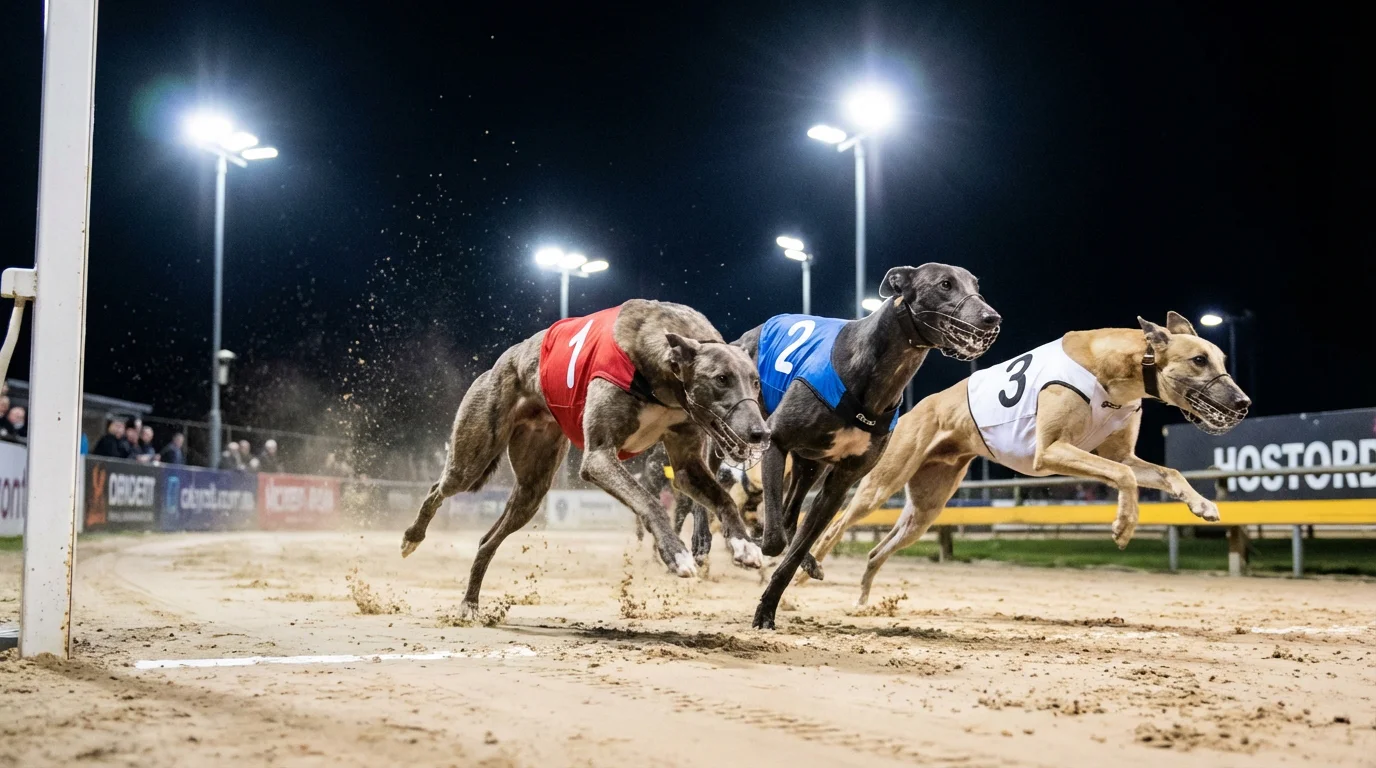
Tricasts pay the biggest prices in greyhound racing, but the hit rate is brutal. You need to name the first three finishers in exact order. In a six-dog race, there are 120 possible tricast combinations. Even if you’ve correctly identified the three dogs most likely to fill the frame, you still need them to finish in the precise sequence you’ve predicted. That’s a one-in-six chance of getting the order right within your selected trio — on top of the challenge of selecting the right three dogs in the first place.
The payouts reflect that difficulty. A tricast involving a moderate favourite, a mid-priced second, and a longer-priced third can easily return £100 to £300 for a £1 stake. If all three are outsiders, the dividend can run into four figures. These are the returns that make tricast betting seductive, and they’re also the returns that make it dangerous for undisciplined punters who chase big numbers without a clear rationale for their selections.
Like forecasts, tricast bets at most UK bookmakers are settled at the computer tricast dividend, calculated from the SPs of all runners. Fixed-odds tricasts are available at some bookmakers but are less common than fixed-odds forecasts, and the prices are typically conservative. The CSF tricast dividend is almost always the better deal, which means you’re accepting uncertainty about the exact payout at the time of placing the bet.
Tricasts require a minimum of three runners, and in practice, they’re most commonly offered on races with four or more. The six-dog greyhound field is actually one of the better environments for tricast betting, because the smaller field reduces the number of possible outcomes compared to horse racing, where fields of 12 or more make exact-order predictions exponentially harder.
Reverse Forecasts and Combination Tricasts
Cover more outcomes at the cost of a higher stake. A reverse forecast removes the order requirement: you select two dogs, and the bet pays if they finish first and second in either order. Mechanically, a reverse forecast is simply two straight forecasts — Dog A first and Dog B second, or Dog B first and Dog A second — so it costs twice the unit stake. The payout depends on which way round the result falls, because the CSF dividend changes depending on which dog wins and which places.
A combination tricast applies the same logic to three-dog selections. You pick three dogs and cover all six possible finishing orders. The cost is six times the unit stake, since there are six permutations of three runners. If any combination of your three dogs fills the first three places, the bet wins. The payout is the CSF tricast dividend for the specific order that occurred, which means the return varies depending on which of the six permutations comes in.
Combination bets are the natural choice when you have a strong view on which dogs will be involved in the finish but less confidence about the exact order. In greyhound racing, where the first bend can reshuffle positions dramatically, this happens often. You might identify three dogs with the best early pace and race fitness, but predicting which one leads off the second bend and which one closes late is genuinely difficult. A combination tricast lets you express the view “these three dogs will dominate this race” without committing to a specific sequence.
The trade-off is mathematical. A £1 combination tricast costs £6. If the resulting dividend is £60, your return is solid. If it’s £20, you’ve made a modest profit. If it’s £12, you’ve barely doubled your money. Combination bets only make sense when you expect the dividend to be large enough to justify the multiplied stake — which generally means at least one of your three selections should be at a longer price.
Using Forecasts and Tricasts in Derby Betting
The Derby final’s six-dog field makes these bets more viable than in open racing. With only six runners and extensive form data available from the preceding five or six rounds, you’re working with more information per dog than in virtually any other greyhound race during the year. Every finalist has run multiple times at Towcester under race conditions. Sectional times, trap behaviour, bend running, and finishing effort are all on the record. This is the one race where forecast and tricast selections can be based on genuine analysis rather than guesswork.
The semi-finals offer a similar opportunity, with the added dimension that you can sometimes identify heat compositions where one or two dogs are clearly outclassed. If a semi-final heat contains two elite dogs and a clear third-best runner, a combination forecast on the top two — with a possible tricast incorporating the third — gives you structured exposure to likely outcomes without requiring heroic predictions about order.
Earlier rounds are less suited to exotic bets. In Round 1, dogs may be racing at Towcester for the first time, trap draws are fresh, and form lines from different tracks are difficult to compare directly. The uncertainty is too high for bets that demand precise predictions about finishing order. Save the forecasts and tricasts for the rounds where you know the dogs, know the track, and know the draw.
One practical consideration for Derby forecast betting: the ante-post outright market and the individual-race forecast market are separate. You can have an ante-post bet on a dog to win the Derby overall while also placing forecasts on specific heats as the tournament progresses. The two don’t conflict, and combining them can create a portfolio approach to your Derby betting — a long-odds outright position supplemented by race-specific exotic bets where the form and draw align.
High Risk, High Return — But Only With an Edge
Exotic bets reward specific knowledge, not general optimism. The punter who places a forecast because they “fancy two dogs” is gambling. The punter who places a forecast because they’ve identified a pace matchup where Dog A’s early speed and Dog B’s strong run-home time make a specific finishing order more likely than the market implies — that punter is betting with an edge.
Forecasts and tricasts will always have a low strike rate. That’s built into the mathematics. But in a six-dog field with published form data and consistent track conditions, the number of plausible outcomes is smaller than the raw permutation count suggests. The dogs that can’t lead off the second bend rarely win. The dog with the best sectional and the inside draw finishes in the first two more often than not. These patterns don’t guarantee results, but they narrow the field of realistic combinations — and that’s where the value in exotic greyhound betting lives.