

Only Four Have Done It
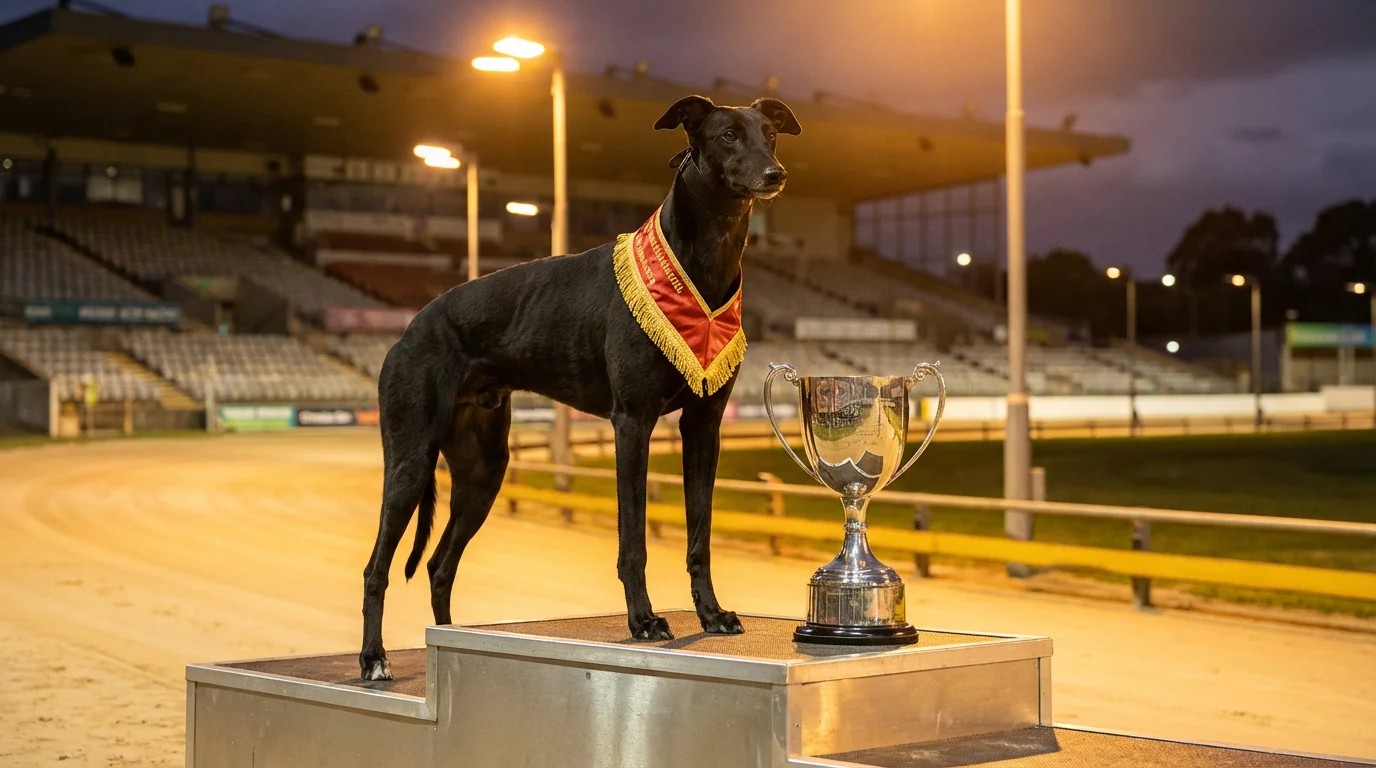
Only four greyhounds in history have won the Derby twice. Each one earned the word “great.” In a sport that produces thousands of runners every year and has held its premier championship since 1927, just four dogs have managed to win the English Greyhound Derby on two separate occasions. That statistic, more than any other, defines the difficulty of what repeating as champion requires. It is not enough to be the fastest dog in the country in one year. You must be the fastest — and the luckiest, and the most durable — in two consecutive campaigns, navigating the random draw, the knockout format, and the physical toll of twelve championship-level races across two summers.
The four double winners span the full breadth of the Derby’s history: Mick the Miller (1929, 1930), Patricias Hope (1972, 1973), Rapid Ranger (2000, 2001), and Westmead Hawk (2005, 2006). Each arrived at their second title by a different path, and each tells a story about what separates a champion from a legend. Their campaigns are not just history — they are case studies in the qualities that make a greyhound capable of something that the overwhelming majority of Derby winners never achieve. (Star Sports — Derby Roll of Honour)
Mick the Miller and Patricias Hope
Mick the Miller didn’t just win twice — he turned greyhound racing into a national conversation. Born in Ireland in 1926, Mick the Miller was a brindle dog of modest size who possessed an extraordinary turn of foot and an even more extraordinary ability to find space in a crowded field. His first Derby victory in 1929 at White City was impressive. His second, in 1930, was historic — the first time any dog had defended the title successfully, an achievement so unusual that it made national newspaper front pages at a time when greyhound racing was competing with football and cricket for the public’s attention. (GBGB — Mick the Miller)
What made Mick the Miller exceptional beyond his speed was his consistency across campaigns. The Derby of the late 1920s was shorter and less formalised than the modern tournament, but the principle was the same: multiple rounds, random draws, elimination at every stage. Mick the Miller handled these demands with a composure that his contemporaries couldn’t match. He raced cleanly, broke well from any trap, and possessed the tactical intelligence to adjust his running line depending on the pace and position of the dogs around him. These qualities — adaptability, composure, and the ability to produce a peak performance on demand — are the same ones that define modern Derby contenders.
Patricias Hope repeated the feat four decades later, winning in 1972 and 1973. Trained by Adam Jackson for his first title and by Johnny O’Connor for his second, Patricias Hope was a different type of champion: a physically imposing dog with relentless early pace who dominated races from the front. Where Mick the Miller adapted to circumstances, Patricias Hope imposed his will on them. His first Derby campaign was a procession. His second was harder — returning from stud duties under a new trainer, he faced a field that knew what to expect, a draw that worked against him in the semi-final, and a final that required a performance of sustained intensity that left the opposition beaten before the third bend. (GBGB — Patricias Hope)
Patricias Hope’s defence illustrated a truth that every subsequent defending champion has confronted: the second title is harder than the first. The market expects you. The other trainers target you. The draw treats you no differently. And your body is a year older, with the accumulated racing miles that come with being the dog everyone wanted to beat for twelve months. Patricias Hope overcame all of that. Most defending champions since have not.
Rapid Ranger and Westmead Hawk
Rapid Ranger had raw power. He won the Derby in 2000 and 2001, bridging the millennium with back-to-back titles that cemented him as one of the greatest greyhounds of the modern era. Trained by Charlie Lister — the most successful Derby trainer in history with seven titles — Rapid Ranger was a physically formidable dog whose early pace was devastating. He broke from the traps like something detonating and was typically two lengths clear by the first bend, a margin that left the rest of the field racing for second. (GBGB — Rapid Ranger)
Rapid Ranger’s first Derby was dominant. His second was a masterclass in managing a defending campaign. Lister brought the dog back to peak condition through a carefully planned race schedule, avoiding the temptation to over-race between Derbies and arriving at Wimbledon with a dog that was fresh, sharp, and physically at its best. The final itself required Rapid Ranger to produce a performance close to his personal best — proof that the second title demands everything, even from the most talented dog in the field.
Westmead Hawk had drama — swooping from behind in some of the most memorable finishes in Derby history. His 2005 victory at Wimbledon was a stunning come-from-behind triumph: slowly away from Trap 4, he trailed the field into the first bend before producing a breathtaking burst of late speed to overhaul the leader Blonde Mac on the final turn and win by a length and three-quarters. His 2006 defence followed the same dramatic script. Running in second place behind Mineola Farloe for most of the race, Westmead Hawk bided his time before unleashing his trademark late pace off the final bend, hitting the front in the closing strides to win by three-quarters of a length — a finish that had the crowd and the commentator in disbelief. (GBGB — Westmead Hawk)
Westmead Hawk’s two victories are often cited as among the greatest performances in Derby history, not because of the winning times but because of what they revealed about the dog’s character. To sit off the pace and produce a devastating late surge to win a Derby final — not once but twice — requires pace, stamina, tactical awareness, and an almost irrational refusal to accept defeat. These are not trainable qualities. They are innate — the product of genetics, temperament, and whatever internal drive separates a great racehound from a good one.
Why Defending the Derby Is Nearly Impossible
Six rounds. Different draws. A year older. The maths works against every defending champion. The structural difficulty of winning two consecutive Derbies is extreme, and it starts with probability. Even if a defending champion has a 25% chance of winning the final — roughly double the average runner’s chance — it still needs to navigate five elimination rounds to reach the final. At a generous 80% chance of progressing through each round, the cumulative probability of reaching the final is roughly 33%. Multiply that by the 25% win probability in the final, and the defending champion has approximately an 8% chance of retaining the title before accounting for physical aging, cumulative racing miles, and the random trap draw.
The physical toll is the least discussed factor but perhaps the most significant. A greyhound that wins the Derby has raced six times at maximum intensity over five to six weeks. It then spends the following twelve months as the sport’s top-rated dog, racing in prestige events and being trained to maintain the condition that won the title. By the time the next Derby arrives, the dog has had a full season of elite-level racing on top of the previous year’s campaign. The freshness that characterised its first Derby entry is harder to reproduce.
The market consistently underestimates this difficulty. Defending champions are often sent off at short prices in their first-round heats, as if the previous year’s title provides protection against the draw, the interference, and the physical grind that eliminates dozens of other talented dogs. The four double winners are proof that it can be done. The dozens of failed defences are proof that it almost never is.
Legends Don’t Repeat — They Persist
Double winners aren’t just fast dogs. They’re dogs that handled pressure across two campaigns — twelve rounds of championship racing, twelve random draws, twelve first bends where everything could end — and came out the other side with two titles. The quality they share isn’t speed, though they all had it. It’s durability in the broadest sense: physical durability to sustain peak condition across two summers, mental durability to maintain composure under the Derby’s unique pressures, and competitive durability to reproduce their best form when the field was specifically targeting them.
For punters assessing the 2026 Derby, the history of double winners provides a clear framework. If the previous year’s champion enters, ask three questions. Has it maintained its physical condition since the last Derby? Does it still possess the early pace or closing speed that defined its winning campaign? And has the trainer managed the intervening year to preserve the dog’s freshness rather than exploit its reputation? If the answer to all three is yes, the defending champion deserves respect. If any answer is doubtful, the history of failed defences tells you exactly how to price it.
Four dogs in nearly a century. That’s the standard. The next double winner will earn a place alongside Mick the Miller, Patricias Hope, Rapid Ranger, and Westmead Hawk — in a club so exclusive that the door barely opens once per generation.
