Best Greyhound Betting Sites – Bet on Greyhounds in 2026
Loading...
The Favourite’s Record in the Derby Final Is Worse Than You Think
Only two favourites have won the Derby final in the last sixteen years. That statistic alone should reshape how you think about backing the market leader on the biggest night in UK greyhound racing. In a sport where favourites win roughly one in three standard races, the Derby final favourite converts at a rate significantly below that — a pattern that has persisted for long enough to be considered structural rather than a short-term anomaly.
The reasons are specific to the Derby’s format. A multi-round knockout tournament over six weeks tests qualities that everyday graded racing does not: durability, adaptability to changing trap draws, the ability to perform under physical accumulation, and the raw luck of avoiding crowding at the first bend across multiple high-pressure races. The market favourite going into the final is the dog that the betting public believes handled all of those variables best through the tournament. But the final itself introduces one more roll of the dice — the last trap draw, the last first bend, the last 30 seconds of racing — and that final layer of randomness punishes short-priced favourites more often than it should.
Understanding why favourites underperform in the Derby is not just a historical curiosity. It’s a practical guide to where the value lies on final night, and by extension, throughout the tournament.
Historical Favourite Strike Rate in Derby Finals
Since 1985, backing every Derby favourite to level stakes would have lost you money. The exact figures depend on which starting prices you use and how you define “favourite” in years where joint-favourites headed the market, but the overall trend is clear and consistent: the Derby final favourite wins less frequently than probability-adjusted odds would suggest.
In the modern era — roughly the last two decades — the Derby final favourite has won approximately once every six to eight renewals. Some periods have been worse. There was a stretch in the late 2000s and 2010s where the favourite lost seven consecutive finals, a sequence that would be remarkable in almost any other betting market. The dogs that won during those years were typically priced between 5/1 and 16/1, with occasional longer-priced surprises that blew the market apart.
The favourite’s place record is marginally better than its win record — the market leader finishes in the first two more often than it wins — but not by enough to make each-way betting on the favourite consistently profitable either. At the prices typically available on the Derby final favourite, which rarely exceed 2/1 and sometimes dip below evens, the each-way place return doesn’t compensate for the frequency of finishing outside the first two.
This data does not mean that the favourite can never win. It clearly can, and in some years the favourite is a genuinely dominant animal whose price reflects a level of superiority that the final simply confirms. But those years are the exception. The base rate for favourite success in the Derby final is low enough that any punter routinely backing the market leader on final night is swimming against the statistical current.
It is worth noting that the favourite’s record in the earlier rounds is much stronger. In individual heats through the tournament, the favourite wins at a rate closer to the general greyhound racing average — somewhere around 30-35%. The underperformance is concentrated in the final itself, where the six surviving dogs are the most closely matched, the stakes are highest, and the variables most compressed.
Why Favourites Underperform in the Derby
Six rounds of attrition, unpredictable trap draws, and one bad bend. These are the three primary forces that conspire against the Derby favourite, and they interact in ways that amplify each other.
Physical attrition is the most underappreciated factor. By the time a dog reaches the final, it has raced competitively at Towcester five or six times over the preceding weeks. Each race demands maximum effort — no dog coasts through a Derby heat. The sand surface extracts a toll on muscles and joints, and while all six finalists have endured the same tournament, the favourite has often been asked the hardest questions. It may have faced stronger opposition in its earlier rounds, been forced wider on the bends, or been pushed to run faster times to justify its market position. The cumulative effect of six maximum-effort races is not evenly distributed, and the dog at the top of the market frequently arrives at the final carrying more fatigue than its price implies.
The trap draw is random and makes no concession to form or market position. A dog that blazed through the semi-finals from Trap 1 might be drawn in Trap 5 for the final. If it’s a natural railer — which many favourites are, because inside-drawn dogs that lead win the most races and therefore accumulate the strongest-looking form — that wide draw neutralises the very running style that made it favourite. The market adjusts for the draw, shortening dogs in favourable traps and drifting those drawn wide, but the adjustment is often insufficient. Punters are reluctant to abandon a dog that dominated the semi-finals just because of a trap number, so the favourite frequently trades shorter than the draw warrants.
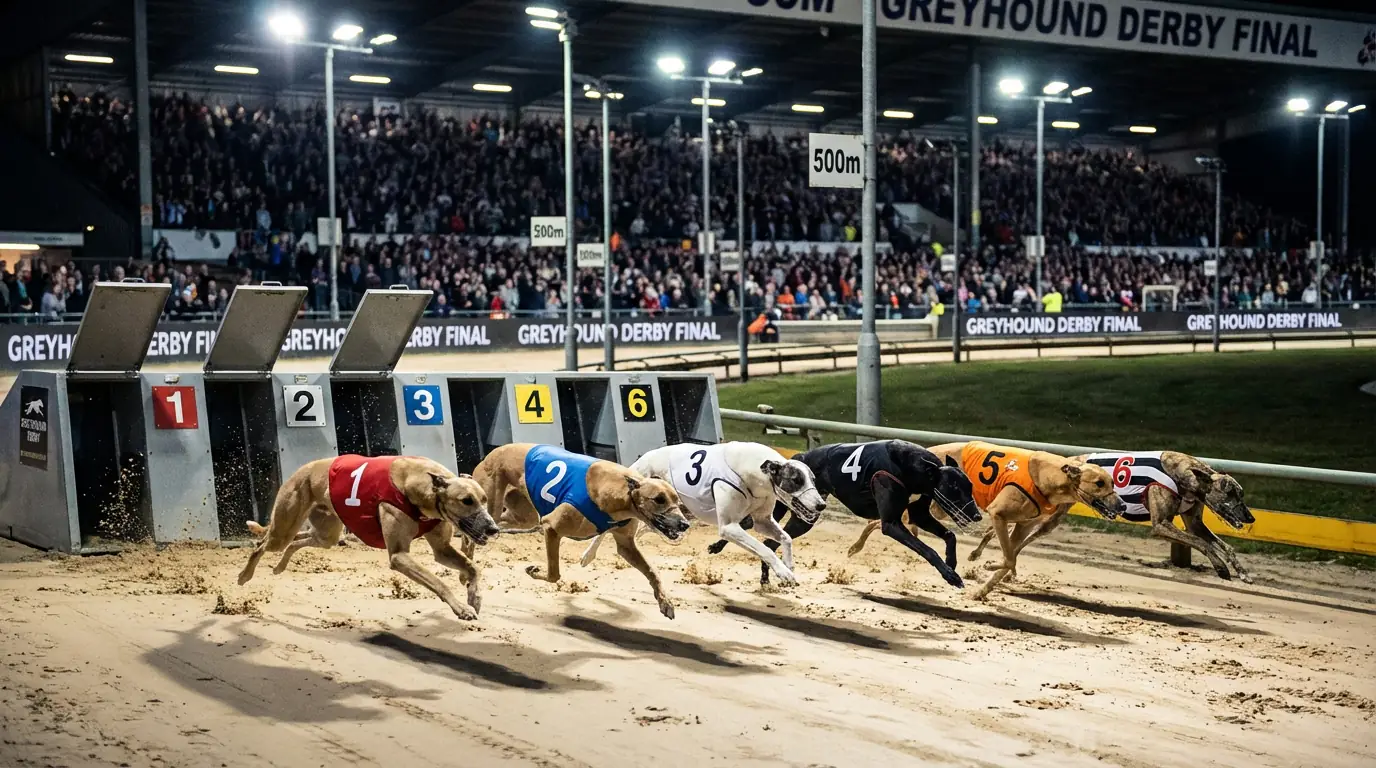
The first bend in the Derby final is the most consequential 50 metres in UK greyhound racing. Six elite dogs breaking from the traps at maximum speed, fighting for position into a turn that can only accommodate two or three of them cleanly. Crowding, checking, and interference at the first bend are not unusual — they are normal. The dog at the front of the market is not immune to these incidents, and a single moment of contact at the first turn can cost enough ground to turn a dominant performer into a beaten one. In everyday racing, the favourite can survive occasional trouble because the opposition is weaker. In the Derby final, every dog is capable of exploiting that lost ground.
Where the Value Lies If Not With the Favourite
Second and third favourites in the Derby have a far better ROI over time. The data consistently shows that the value in Derby finals sits not at the top of the market but one or two ticks down — the dogs priced between 4/1 and 10/1 that the market respects but doesn’t crown.
These dogs have several characteristics in common. They have progressed through the tournament without being asked to produce their absolute best in every round. They may have qualified as winners of weaker heats or as fastest losers in tougher ones, arriving at the final with less public expectation and, crucially, less physical wear. Their form lines might include a third-place finish in a semi-final that the market reads as a weakness but that actually reflects a tactical run behind faster dogs — a performance that preserved energy rather than spent it.
The trap draw often creates value in the 5/1 to 10/1 range. A dog drawn in Trap 2 or 3 with good early pace might drift to 7/1 because the favourite occupies the adjacent trap and the market assumes the favourite will lead. If your form analysis suggests the pace matchup is closer than the market believes, that 7/1 is an overlay — a price longer than the dog’s true chance of winning.
Outsiders at 14/1 and beyond win the Derby occasionally, but not often enough to be a systematic strategy. The value zone, historically, is the 4/1 to 10/1 band — dogs good enough to win but not burdened by the expectations, the price, and the physical demands that come with being the favourite.
Assessing the 2026 Derby Favourite
The market has its pick. Here’s how to assess whether the price is right. As the 2026 Derby field takes shape, the ante-post favourite will emerge from a combination of trial reports, early-round results, and trainer reputation. Before you accept or reject that favourite, run through a checklist that the historical data suggests matters most.
First, how many rounds has the dog won in dominant fashion — breaking clear, leading throughout, winning by daylight? If the answer is most or all, the dog may be arriving at the final having spent more energy than its rivals. Second, what is its trap-draw dependency? If the dog’s best form is exclusively from inside traps and it draws wide in the final, the price should reflect that limitation. If the market hasn’t adjusted enough, oppose it. Third, how does its early pace compare to the other five finalists? If two or three dogs have similar first-bend speed, the risk of first-bend interference rises sharply — and that risk is not the favourite’s friend.
The favourite can win. It has won before and will again. But the question for punters is never “can it win?” — it’s “does the price compensate me fairly for the probability that it will?” In the Derby final, the answer is usually no.
The Market Is Usually Right — Except in the Derby
The Derby’s knockout format creates chaos that flat-track form can’t predict. That is the irreducible truth of this event, and it is the reason the favourite’s record is so poor relative to expectations. In a single race at a midweek meeting, the best dog usually wins. In a six-round tournament culminating in a single final where the trap draw is random and the first bend is a lottery of physics and positioning, the best dog wins less often than the market assumes.
This doesn’t mean you should blindly oppose the favourite. It means you should demand a longer price for backing it, and you should look seriously at the dogs in the 4/1 to 10/1 window whose profiles match the historical pattern of Derby winners — fresh, adaptable, less publicly fancied, and drawn to exploit the first bend rather than survive it. The Derby rewards those who question the obvious choice. The favourite is always the obvious choice. Question it.