

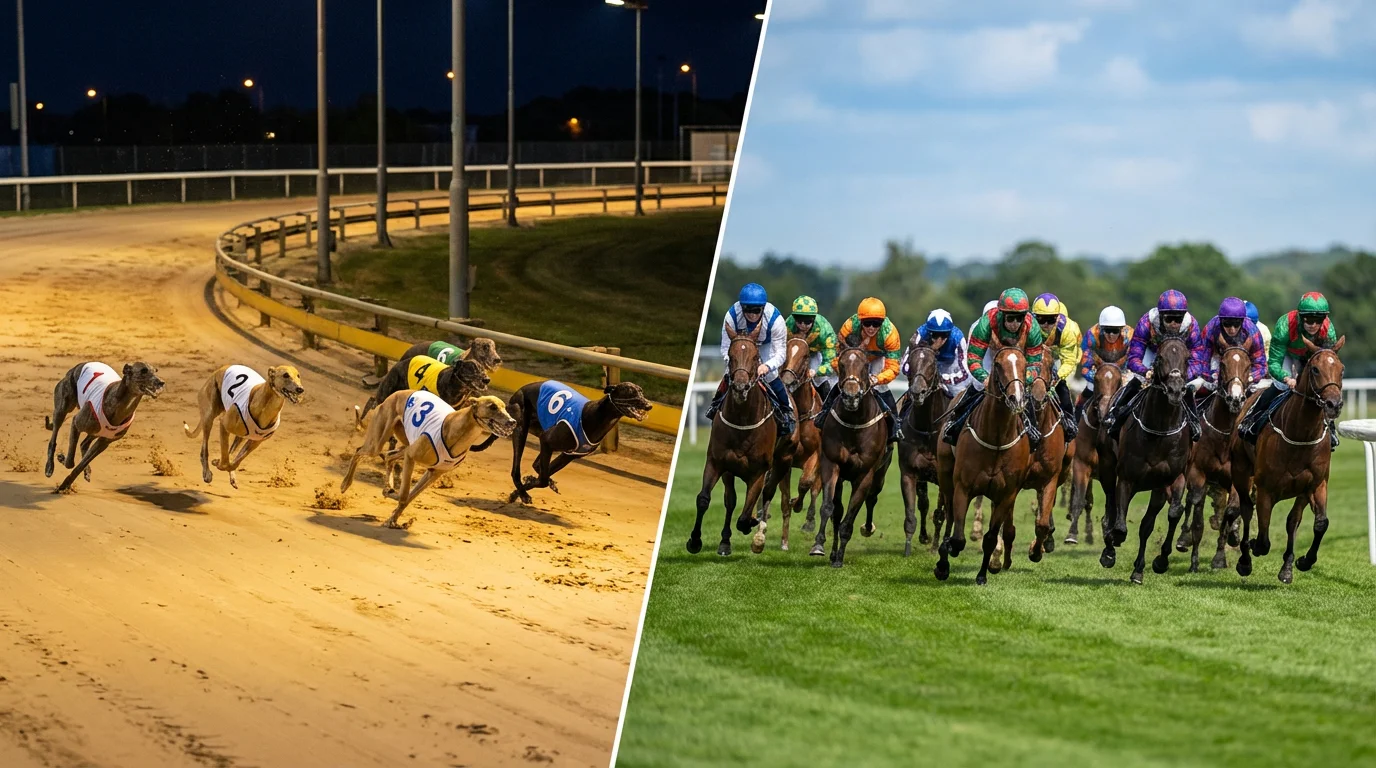
Same Instincts, Different Mechanics
Horse racing punters crossing over to greyhounds make the same mistake: assuming the skills transfer directly. The analytical mindset does transfer — both sports reward punters who study form, understand pace, and respect value. But the specific mechanics of greyhound racing — smaller fields, higher race frequency, different market dynamics, and the dominance of the first bend — create a betting environment that operates on different rules. A horse racing punter who applies their existing framework without adjusting for these differences will lose money that they wouldn’t lose on the flat or over jumps.
The reverse also applies. Greyhound punters moving into horse racing discover fields of fourteen runners, going reports that change every hour, and a market depth that makes greyhound betting look like a puddle beside a lake. Each sport has developed its own analytical culture, its own data ecosystem, and its own set of profitable habits. Understanding the differences is essential for anyone who bets on both — or who’s considering crossing over from one to the other.
Field Size, Pace and Market Dynamics
Six dogs vs fourteen horses. The smaller field changes everything — odds, tactics, variance. The most fundamental difference between greyhound and horse racing from a betting perspective is the number of runners. A greyhound race has six dogs. A horse race can have anywhere from four to thirty or more, with typical handicap fields numbering twelve to sixteen.
This difference has cascading effects on the betting market. In a six-dog race, the mathematical minimum probability for each runner is roughly 16.7%. Even the rank outsider has a baseline chance that exceeds what a 20-runner horse race outsider possesses. This compresses the odds range. Greyhound favourites rarely go off shorter than 6/4, and genuine outsiders rarely drift beyond 20/1 or 25/1. In horse racing, favourites can be odds-on while outsiders might be 100/1 or more. The compressed odds range in greyhound racing means that value margins are tighter — the difference between a fair price and an overlay is often a single point of odds rather than several.
Pace analysis is central to both sports but operates differently. In horse racing, pace is influenced by the jockey’s tactical decisions — when to push, when to wait, when to make a move. In greyhound racing, pace is instinctive. The dog breaks from the traps and runs its natural race without tactical intervention. This makes pace more predictable in greyhound racing: a dog that shows early pace in its form figures will show early pace today. It also makes the first bend the critical moment of the race, because six dogs converging on a single turn at maximum speed, without riders to steer them, produces a bottleneck that has no equivalent in horse racing.
The betting market for greyhound races is thinner than for horse racing. Fewer punters, less money, and less sophisticated market-making create wider price discrepancies between bookmakers and more opportunities for value — but also more volatility. A single large bet can move a greyhound price by several points, whereas the horse racing market absorbs much larger volumes without significant price movement. This thinness cuts both ways: it creates opportunities for informed punters but also means that the market is less efficient at reflecting true probabilities.
Form, Conditions and Race Frequency
Greyhounds race far more often than horses. Form cycles are faster, and fitness windows are tighter. A racehorse might run ten to fifteen times in a season, with weeks or months between races. A racing greyhound can run twice a week, accumulating fifty or more races in a year. This frequency means that greyhound form is more current but also more volatile — a dog’s condition can change between Tuesday and Saturday in ways that a horse’s condition rarely changes between Cheltenham and Aintree.
The form cycle in greyhound racing is compressed. A dog that wins three races in a row might be regraded upward within a fortnight, facing tougher competition before its physical peak has passed. A horse that wins three races in a row might not be handicapped upward for weeks, giving its trainer time to plan the next campaign. Greyhound punters need to read form as a rapidly updating signal, checking for the most recent two or three runs rather than building a picture over months.
Conditions affect both sports but are accounted for differently. Horse racing has a formal going system — firm, good, soft, heavy — that is published, discussed, and integrated into the market as a matter of course. Greyhound racing has no equivalent public going report. The surface condition varies by weather and maintenance, but punters must assess it themselves by watching early-race times or noting weather forecasts. This asymmetry means that conditions are more fully priced into the horse racing market than the greyhound market, creating an edge for greyhound punters who take the trouble to assess them.
The trainer’s role differs significantly. A horse trainer makes strategic decisions about race selection, distance, ground preference, and campaign timing. A greyhound trainer has less control — the racing manager assigns the dog to races based on its grade, and the trap draw is random. The trainer’s influence is concentrated in physical preparation: keeping the dog in peak condition, managing weight, and timing the peak to coincide with the target event. In horse racing, the trainer is a strategist. In greyhound racing, the trainer is a conditioner.
Betting Markets and Available Bet Types
Forecast and tricast dominate greyhound betting in a way they don’t in horse racing. While both sports offer win, each-way, forecast, and accumulator markets, the relative popularity and value of each differs.
In horse racing, win and each-way betting dominate the market. Forecasts and tricasts exist but are a minority pursuit, partly because large fields make the number of possible combinations unwieldy and partly because the fixed-odds prices on individual horses already provide deep markets to exploit. In greyhound racing, forecasts and tricasts are mainstream — the small field of six dogs makes the number of combinations manageable, and the tote forecast and tricast dividends regularly offer returns that exceed the bookmaker’s computer prices.
Each-way betting works differently in practice. A horse race each-way bet typically pays on three or four places depending on field size. A greyhound each-way bet pays on the first two finishers in a six-dog race, at 1/4 odds. The place element of a greyhound each-way bet is therefore a relatively generous proportion of the field — one-third — which makes each-way betting proportionally more valuable in greyhound racing than in large-field horse races where the place fraction covers a smaller proportion of the field.
Ante-post markets behave differently too. Horse racing ante-post markets can open months before a race, with prices fluctuating based on entry declarations, trainer comments, and trial performances. Greyhound ante-post markets are typically available only for major events like the Derby, and the market is less liquid and less responsive to information. This creates opportunities — ante-post prices on Derby entries can remain at levels that don’t reflect emerging form — but also risks, as the absence of a deep ante-post market means there are fewer data points to validate your own assessment.
Different Sand, Same Discipline
The analytical mindset translates. The specifics don’t. If you’re a horse racing punter exploring greyhound betting, the core skills — form analysis, value assessment, bankroll management, and disciplined staking — all apply. What doesn’t transfer is the specific knowledge: the importance of trap draws, the role of the first bend, the compressed odds range, the higher race frequency, and the different market dynamics.
The adjustment period is shorter than you might expect. A few evenings spent watching greyhound racing, reading the form cards, and placing small bets to calibrate your understanding of the market will establish the foundation. The Derby, as the sport’s highest-profile event, is an excellent entry point — it attracts more media coverage, more market depth, and more analytical content than any other greyhound meeting, giving newcomers from horse racing a richer information environment to learn in.
The punters who succeed across both sports are the ones who recognise the differences rather than ignoring them. Greyhound racing rewards a slightly different set of analytical priorities than horse racing. Adapting to those priorities isn’t a compromise. It’s an expansion of your betting intelligence into a market that, precisely because it’s less crowded and less efficient, offers opportunities that the deeper horse racing market has already priced away.
