Best Greyhound Betting Sites – Bet on Greyhounds in 2026
Loading...
Eighteen licensed tracks. Each with its own quirks, its own pace, its own way of punishing the unprepared. UK greyhound racing operates across a network of GBGB-licensed stadiums that stretches from Romford in east London to Kinsley in West Yorkshire, from Hove on the south coast to Sunderland in the north-east. These tracks are not interchangeable. They differ in circuit geometry, bend configuration, surface composition, standard racing distances and the specific biases that their layouts produce. A dog’s form at one venue tells you something precise about that venue. Whether it tells you anything useful about another depends entirely on how well you understand the differences.
For casual bettors, a greyhound race is a greyhound race: six dogs, traps, a bend, a finish line. For anyone trying to bet seriously, that simplification is the first thing to abandon. The track is not a neutral container. It shapes the race. A tight circuit with sharp bends rewards inside-trap speed and punishes wide runners. A galloping track with sweeping turns favours dogs with sustained pace and efficient cornering. The sand surface at one venue runs faster than the sand at another, and conditions on any given evening can shift times by several tenths of a second. Every one of these variables affects the result, and by extension, the value of your bet.
Towcester sits at the centre of this landscape, not because it’s the most typical UK track — it isn’t — but because it hosts the Greyhound Derby. The Derby is the event that concentrates the sport’s best dogs, its biggest betting market and its highest public attention into one venue over six weeks. Understanding Towcester’s specific characteristics is therefore the starting point for any serious Derby analysis. But understanding it in isolation is not enough. The dogs that compete in the Derby arrive with form from tracks across Britain and Ireland, and assessing that form requires knowing how each track’s peculiarities translate — or don’t — to the Towcester circuit.
This guide profiles the tracks that matter most for UK greyhound betting: Towcester in depth, the major open-class venues in summary, and the BAGS circuit that provides the daily bread-and-butter of the sport. It then examines how track differences create betting opportunities and traps, and closes with a look at the closures that have reshaped the circuit in recent years.
Towcester Greyhound Stadium: The Derby Home
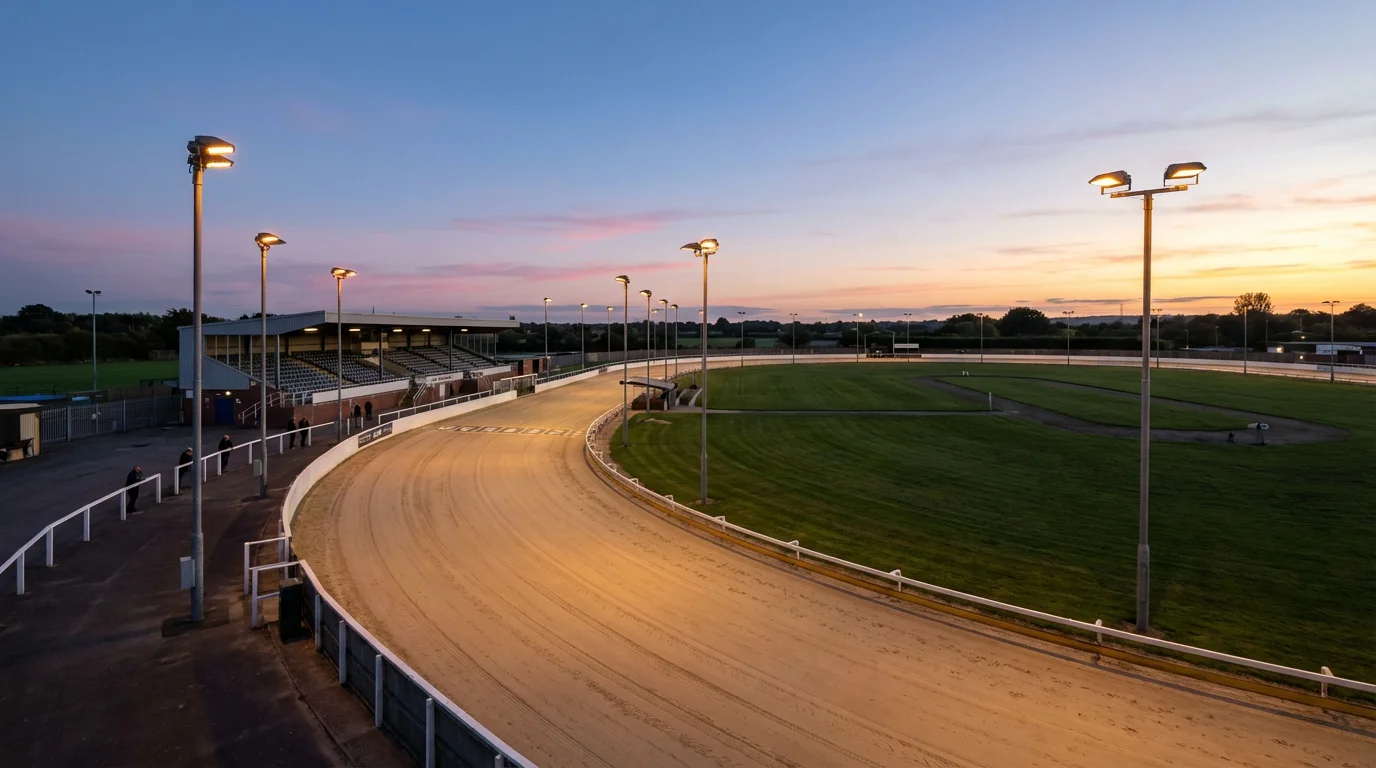
Towcester is a power track — and the dogs that thrive here earn every yard. Situated adjacent to the horse racing course in rural Northamptonshire, Towcester Greyhound Stadium became the permanent home of the English Greyhound Derby in 2017 after the closure of Wimbledon. The transition was not seamless — Towcester itself entered administration in 2018, forcing the Derby to relocate temporarily to Nottingham — but since its return, the stadium has established itself as the sport’s flagship venue. Enough racing has now taken place at Towcester to build a reliable dataset on track behaviour, surface patterns and the competitive dynamics the circuit produces.
Track Configuration and 500m Distance
The Derby is contested over 500 metres on sand, with four left-hand bends and a standard six-trap start. Within that specification, the details matter. Towcester’s circuit is larger than the majority of UK greyhound tracks, and its geometry produces racing dynamics that differ meaningfully from tighter venues. The run from the traps to the first bend is relatively long — considerably longer than at compact tracks like Romford or Central Park — which gives dogs more time to establish their racing line before the field converges at the turn.
That longer run has consequences for trap bias. At a tight track, the first bend arrives so quickly that inside traps carry a decisive geometric advantage: the dog in Trap 1 simply has less ground to cover before it reaches the rail. At Towcester, the extended approach moderates this effect. Faster-breaking dogs from middle and outside traps have enough straight running to compete for position, which flattens the trap-bias curve relative to smaller circuits. Inside traps still carry a slight statistical advantage — the geometry makes this inevitable — but the margin is narrower than at Romford or Monmore, and it’s nowhere near determinative.
The bends themselves are sweeping rather than sharp. This rewards dogs with efficient cornering technique — animals that maintain speed through the turns without drifting wide or losing momentum — over pure straight-line sprinters. A dog that dominates at a sharp-bend track by blasting out of the traps and holding the rail may find that its speed advantage is neutralised at Towcester by a rival with a better bend profile. The third bend is the second key decision point: dogs running wide at this stage lose significant ground, and the finishing straight is not long enough to recover it.
The sand surface is typical of modern UK greyhound tracks. Its speed varies with moisture content: dry conditions produce faster times, while rain makes the surface heavier and slows the track by several tenths of a second across a 500-metre race. Surface speed on any given evening is apparent from the early races on the card — if the first three races produce times consistently half a second slower than the previous meeting’s, the track is riding heavy. Adjusting your form assessments for surface speed is essential. A dog that posted 29.20 last week on a fast surface and clocks 29.55 tonight on a heavy track may have run an equivalent or even superior race. The raw time won’t tell you that. The context will.
Towcester Sectional Benchmarks
Sectional times at Towcester split the 500-metre race into two segments: the trap-to-first-bend time — the early-pace sectional — and the first-bend-to-finish time, known as the run-home. These splits are published for all races at the track and represent the most granular performance data available to bettors.
At Towcester over 500 metres, a competitive early-pace sectional in open-class racing typically falls in the range of 4.00 to 4.20 seconds. Anything faster than 4.00 from a middle or outside trap indicates exceptional early speed. Anything slower than 4.30 suggests the dog was slow away or met trouble exiting the traps. The run-home time for a strong open-class dog will generally sit between 25.00 and 25.60 seconds, depending on surface conditions and the intensity of the race.
For Derby analysis, these benchmarks are the most useful comparative tool available. A dog that posts a 4.05 early-pace split at Towcester has demonstrated that it can break fast enough to reach the first bend in a competitive position — the single most important requirement for a Derby contender. A dog with a strong run-home time — sub-25.20 on a standard surface — has the sustained pace to hold its position through the remaining three bends and the finishing straight. The combination of both — a fast break and a strong run-home — is the profile of a genuine Derby finalist, and it’s what the form reader should be looking for when assessing each round’s results.
Major UK Greyhound Tracks at a Glance
Not every track runs the same. Not every form line translates. The UK greyhound circuit comprises venues that range from large, galloping ovals to compact, tight-turning stadiums, and the performance data generated at each is specific to that venue’s characteristics. What follows is a profile of the most significant tracks for bettors — the open-class venues that host the strongest fields, and the BAGS tracks that provide the daily racing most punters encounter.
Nottingham, Hove and Other Open-Class Venues
Nottingham is the track most often compared to Towcester, and the comparison has some validity. It’s a large, galloping circuit with generous bends and a 500-metre trip that produces racing broadly similar in character to Towcester’s — albeit on a slightly different surface and with its own geometric quirks. Nottingham hosted the Derby in 2019 and 2020 during Towcester’s administration, and dogs that performed well there have historically translated reasonably to Towcester. For punters, Nottingham form is the most portable to the Derby venue, though direct time comparisons remain unreliable. Use the sectional profiles rather than the raw times.
Hove, on the south coast near Brighton, is a well-established track that hosts regular open-class fixtures and several prestige events. Its circuit is mid-sized with a surface that tends to run true in most weather conditions. Hove form is generally reliable as an indicator of quality, though the track’s bend configuration differs enough from Towcester that dogs specialising in tight cornering may find the transition challenging. The track regularly features in the early rounds of national competitions, and dogs that emerge from Hove with strong open-class credentials deserve attention in any Derby assessment.
Romford occupies a unique position in UK greyhound racing. Located in east London, it’s a tight, compact circuit with sharp bends and short straights — the opposite of Towcester in almost every geometric respect. Inside traps carry a significant advantage at Romford, and the track rewards early-pace sprinters who can break fast and hold the rail from start to finish. The results can be dramatic, and the market is lively, but the form is deeply track-specific. A dog that dominates at Romford has proved its speed and its ability to rail, but neither of those qualities guarantees competitiveness at a galloping track where the bends are wider and the race is decided over four turns rather than two. Treat Romford form with caution when it appears on a Derby entrant’s racecard.
Sheffield runs a variety of distances on a circuit that produces its own distinct data set. The track’s open-class events attract quality fields, and its 500-metre trip provides useful comparative data for Towcester assessment — with the caveat that Sheffield’s surface speed and bend tightness are different enough to require sectional adjustment. Monmore Green in Wolverhampton offers another mid-sized circuit with a well-established reputation for competitive racing. Trap 1 overperforms at Monmore in sprints, but the bias moderates at longer distances. Dogs with proven Monmore form in 500-metre races have a reasonable track-style crossover to Towcester, particularly those with strong run-home sectionals.
BAGS Tracks: The Bread-and-Butter Circuit
The BAGS (Bookmakers’ Afternoon Greyhound Service) circuit provides the daily racing that fills afternoon betting shop screens and online cards across the UK. BAGS meetings run at multiple tracks throughout the week, often starting around midday and continuing into the early evening, providing a steady stream of betting opportunities outside the evening BEGS calendar. For many punters, BAGS racing is where the majority of their greyhound bets are placed.
The BAGS circuit includes venues such as Crayford, Perry Barr, Sunderland and Kinsley, alongside afternoon sessions at larger tracks like Romford and Monmore. The competitive standard varies: some BAGS fixtures feature strong graded cards with reliable form, while others — particularly at smaller tracks running low-grade races — produce thinner data and less predictable results. As a general rule, BAGS racing at the more established venues offers better betting value than at the circuit’s smaller stadiums, because the form data is deeper, the market is more efficient, and the pool of dogs is more extensively trialled and graded.
From a Derby perspective, BAGS tracks are rarely the source of genuine contenders. The Derby attracts open-class dogs — the elite of the sport — and these animals typically campaign on the BEGS evening circuit and at prestige fixtures, not at afternoon BAGS meetings. However, BAGS form still has indirect value. A trainer whose kennel is running hot across BAGS fixtures — winning at a high strike rate across multiple tracks — is operating in good form, and that general kennel competence can extend to their open-class runners in major events. Trainer form, as a signal, doesn’t distinguish between afternoon and evening racing. A winning kennel is a winning kennel.
How Track Differences Affect Your Betting
A dog that dominates at Romford might flounder at Towcester — and the racecard won’t tell you why. The form figures will show recent wins. The time will look fast. The comment line might read “Ld, Al” — led all the way. On paper, it looks like a contender. But the wins came at a tight track where the dog’s blistering early pace and inside-rail running style gave it a structural advantage that doesn’t exist at Towcester’s wider circuit. The racecard records what happened. It doesn’t explain what the track’s geometry contributed to the result.
This is the central challenge of cross-track form assessment, and it’s the area where most casual bettors make their most expensive mistakes. Greyhound form is venue-specific to a degree that horse racing form is not. A horse’s ability to gallop is transferable across courses with broadly similar characteristics — a horse that wins at Ascot over a mile is a genuine contender at Newmarket over the same distance, adjusting for ground and draw. Greyhound racing doesn’t work that way. The physical act of running around a sand track with tight bends is fundamentally different from running around a track with sweeping bends, even over the same nominal distance. The dog that excels at one may genuinely struggle at the other, and the struggle won’t be visible in its previous form figures.
The practical framework for handling this is to classify tracks by type and assess form portability between types rather than between individual venues. Broadly, UK tracks fall into three categories. Tight tracks — Romford, Central Park, Crayford — feature sharp bends, short runs to the first turn, and strong inside-trap bias. They reward early pace and railing ability above all else. Galloping tracks — Towcester, Nottingham, Sheffield — feature wider bends, longer straights, and a more moderate trap bias. They reward sustained pace, efficient cornering, and stamina. Mid-sized tracks — Monmore, Hove, Sunderland — sit between the two extremes and produce form that is partially transferable in both directions.
When you see a dog’s form from a tight track appearing on a racecard at a galloping venue, apply a discount. Not to the dog’s ability — it may be genuinely talented — but to the relevance of its recent results. The opposite applies too: a dog with moderate form at a galloping track, moving to a tight venue, might outperform its recent times if its running style suits the new geometry. These are not guaranteed outcomes. They’re probability adjustments, and making them consistently is one of the most reliable ways to improve your strike rate.
Sectional times offer a partial solution to the portability problem. While raw finishing times are meaningless across different tracks, the ratio between early-pace and run-home sectionals tells you something transferable about the dog’s running style. A dog with a fast early sectional relative to its run-home time is a front-runner that relies on breaking fast and maintaining a rail position. This style transfers well to tight tracks and poorly to galloping tracks. A dog with a moderate early sectional but a notably fast run-home is a closer — a dog that recovers from a slow start and finishes strongly. This style transfers better to galloping tracks where the longer circuit allows time to make up ground.
Surface conditions add another layer of complexity. All modern UK greyhound tracks use sand, but the composition, drainage characteristics and maintenance schedules vary. A track that drains quickly produces consistent surface speeds across wet and dry conditions. A track that holds moisture will ride significantly slower after rain, rewarding stayers and penalising dogs that depend on a fast surface to produce their best times. At Towcester, the surface is sensitive to rainfall — Derby punters should check the weather forecast before finalising their assessments for any given round. A dog whose best form came on a fast surface may underperform on a rain-affected track, and that underperformance isn’t a form decline — it’s a conditions mismatch.
The final variable is course knowledge. Dogs that have raced at a track before — particularly in recent weeks — have a measurable advantage over first-time visitors. They know the geometry. They know where the bends tighten and where the straight opens up. Their muscle memory is attuned to the specific demands of the circuit. In the Derby, where dogs race at Towcester across multiple rounds, this advantage accumulates: a dog that reaches the semi-finals has now run the track four or five times in competition and has the course experience that a first-round elimination denied its rivals. This is one reason the later rounds of the Derby tend to produce tighter finishes — the surviving dogs have all adapted to the venue, and the advantage of familiarity narrows.
Track Closures and What They Mean for the Sport
Every closure narrows the calendar and concentrates the talent. The UK greyhound racing circuit has contracted significantly over the past three decades, and the trend shows no sign of reversing. Wimbledon’s closure in 2017 was the most high-profile loss — the spiritual home of the Derby, demolished for housing and a football stadium — but it followed a long sequence of closures that had already reshaped the sport. Hall Green in Birmingham, Oxford, and Catford in south-east London are among the tracks that have disappeared, each taking with them a fixture list, a local racing community, and a body of track-specific form data that becomes obsolete the moment the gates close for the last time.
For the sport as a whole, closures are an existential concern. Fewer tracks mean fewer racing opportunities, fewer dogs in competitive training, and a smaller footprint in the public consciousness. The financial model of greyhound racing — dependent on betting turnover, sponsorship, and live-attendance revenue — requires a minimum network of viable venues, and each closure brings the circuit closer to the threshold below which the economics stop working.
For bettors, the impact is more specific. Track closures redistribute dogs and trainers across the remaining venues. When a track closes, its regular runners are rehoused at other stadiums, often requiring a period of adjustment as they learn new circuits with different geometries and surface characteristics. During this transition period, the dogs’ recent form becomes less reliable — their times and finishing positions were recorded on a circuit that no longer exists, and their performance at the new venue is unknown. Shrewd punters can exploit this dislocation: a dog that was dominant at a closed track might be underpriced at its new home if the market doesn’t fully account for the transition, or overpriced if the market assumes past performance will transfer automatically.
Closures also concentrate the strongest dogs at the surviving prestige venues, which has an upward effect on competitive standards. When Hall Green closed, its best dogs moved to Monmore, Nottingham and other venues, raising the quality of graded and open-class racing at those tracks. The same effect followed Wimbledon’s closure. The result, over time, is a circuit where the remaining tracks host stronger fields than they would if the network were larger — which makes form data more reliable, markets more efficient, and the identification of genuine value both harder and more rewarding.
The most significant ongoing closure risk, from a betting perspective, is the potential loss of a track that hosts a major event. The Derby moved from Wimbledon to Towcester, from Towcester to Nottingham, and back to Towcester — each move resetting track-knowledge advantages and producing a period of market inefficiency. If Towcester were to face financial difficulty again, or if another established venue were to close, the same disruption would repeat. History suggests that the first edition of the Derby at any new venue produces longer-priced winners and more volatile markets. If you’re paying attention when that happens, the opportunity is real.
Beyond the Final Bend
The track isn’t just a venue. It shapes the sport — and the bets. Every assessment you make as a greyhound bettor is, at its root, an assessment of a dog’s ability relative to the demands of a specific circuit. Remove the circuit from the equation and the form data is meaningless. A time without a track is a number without a unit. A finishing position without knowledge of the venue’s biases is an outcome without context.
The eighteen tracks currently operating under GBGB licence represent the full spectrum of what UK greyhound racing offers: tight circuits that produce dramatic, pace-dependent racing; galloping ovals where stamina and cornering efficiency matter more than raw speed; mid-sized venues that test a dog’s versatility. Each one generates data that tells you something specific — and something limited. The punter who understands those limitations is better equipped than the one who takes the numbers at face value.
Towcester, as the Derby venue, deserves the most detailed attention. Its configuration, its surface behaviour, its sectional benchmarks, and its trap-draw data should form the core of any serious Derby punter’s preparation. But Towcester does not exist in isolation. The dogs that arrive for the Derby carry form from a dozen different tracks, and the ability to assess what that form means in the context of Towcester’s specific demands is the skill that separates informed betting from guesswork.
The sport’s shrinking geography is a concern for everyone who cares about greyhound racing — participants, fans, regulators and bettors alike. Every closure reduces the calendar, concentrates the competition, and eliminates a body of data that took years to accumulate. But the circuit that remains is more concentrated, more competitive, and better served by publicly available data than at any point in the sport’s history. The information is there. Racecard data, sectional times, results archives, and track-specific statistics are all available through the GBGB and through third-party form services. The question is not whether the data exists, but whether you’re willing to do the work of interpreting it in the context of the track it came from.
Build a mental map of the circuit. Know which tracks are tight and which are galloping. Know where the inside traps dominate and where the bias is flat. Know which venues produce form that transfers well to Towcester and which don’t. That map won’t guarantee you a winner on any given night, but it will prevent you from making the category of error that treats all greyhound form as equivalent. In a sport where the margins are measured in lengths and tenths of a second, the difference between a bettor with track literacy and one without it is the difference between playing with a full hand and playing blind.