Best Greyhound Betting Sites – Bet on Greyhounds in 2026
Loading...
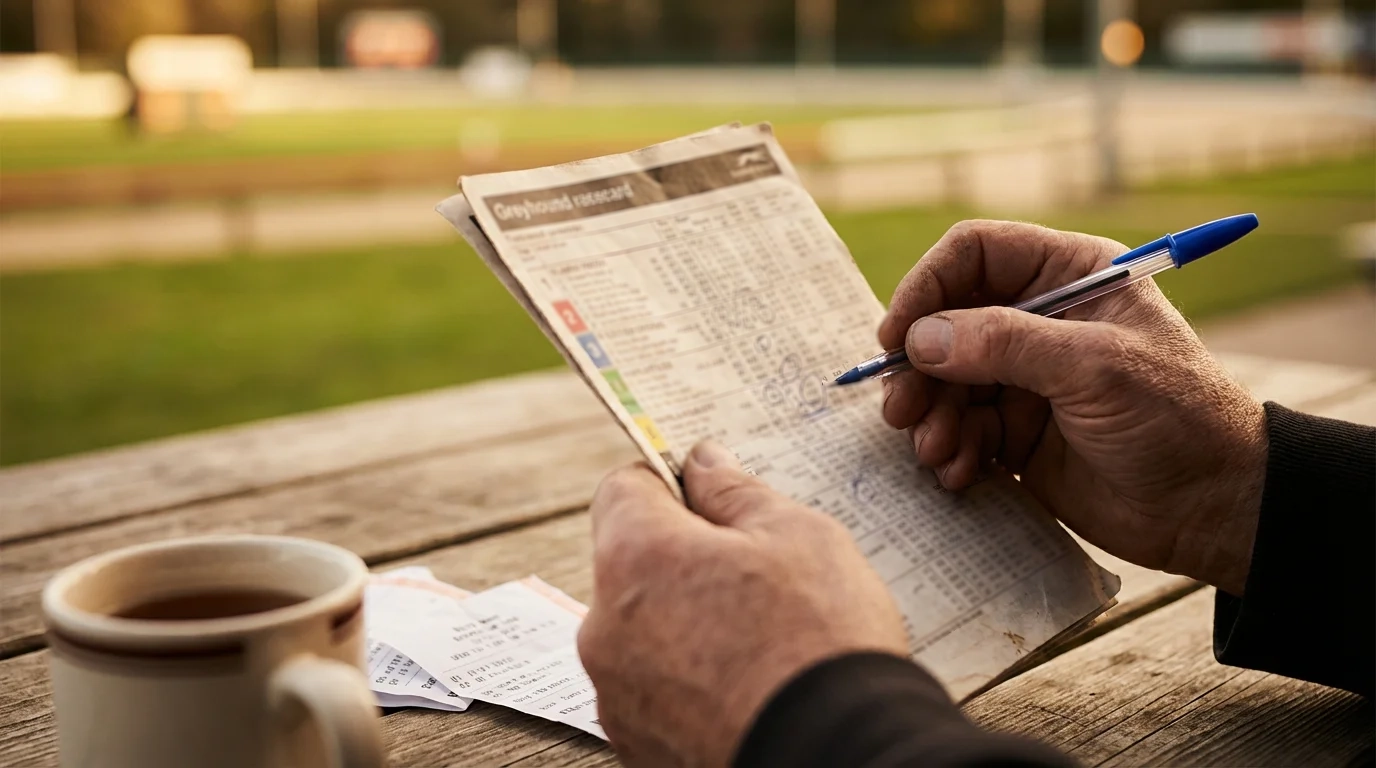
The racecard is the most information-dense document in British sport — and most bettors barely glance at it. A single greyhound racecard contains the dog’s name, trainer, trap number, recent finishing positions, race comments, sectional times, best time at the track, weight, grade, and running-style indicators — all compressed into a few lines of text and numbers. It’s a complete performance profile, and it’s available for free before every race at every licensed track in the country. The punters who use it properly have an edge. The ones who ignore it are guessing.
Form reading in greyhound racing is different from form reading in horse racing, and the differences matter. There are no jockeys making in-race tactical decisions. There’s no ground description to factor in. There are no equipment changes, no blinkers, no tongue-ties. The variables are fewer, which should make the analysis simpler — and in some respects it is. But the margins are tighter. A six-dog race over 500 metres, lasting roughly thirty seconds, is decided by fractions. The difference between first and fourth can be a length — which is less than a second of clock time. In that environment, small informational advantages compound: knowing that a dog is a slow breaker, or that it runs wide on the third bend, or that its trainer is in a losing streak, can shift your assessment from marginal to decisive.
This guide breaks the racecard into its component parts and explains what each piece of information tells you. It then moves beyond the card itself to cover sectional times — the most underused data point in greyhound betting — and the grading system that determines what level of competition each dog is facing. The final sections address the practical question that all form reading should ultimately answer: when the analysis is done, how do you turn it into a bet?
If you’ve been betting on greyhounds by picking the dog with the lowest trap number, or the one whose name you like, or the favourite because it feels safe — this is where that changes. The racecard gives you everything you need to make an informed decision. The rest is discipline.
Anatomy of a Greyhound Racecard
Every column. Every abbreviation. Every piece of data that separates a guess from a decision. The UK greyhound racecard follows a standardised format across all GBGB-licensed tracks, which means that once you learn to read it at one venue, the skill transfers everywhere. The layout may vary slightly between bookmakers’ presentations, but the underlying data is the same: a structured set of performance indicators that, taken together, tell you almost everything you need to know about each dog in the race.
Dog Name, Trainer and Ownership
The dog’s registered name appears at the top of its racecard entry, alongside its sire and dam. The parentage is more than a curiosity — breeding lines in greyhound racing carry meaningful performance indicators, particularly for speed, stamina, and temperament under pressure. A dog sired by a proven Derby performer has a statistically higher likelihood of handling the demands of a multi-round competition than one from an unproven bloodline. In practice, most bettors don’t analyse breeding deeply, but those who do — particularly in ante-post markets where limited form data forces you to look for other signals — can find an edge.
The trainer’s name is the most consistently useful piece of information on the card after the form line itself. In greyhound racing, the trainer has more direct influence on the outcome than in almost any other sport. The trainer controls the dog’s fitness, feeding, exercise regime, and race preparation. A dog trained by a kennel running at a 25% strike rate is, statistically, a stronger proposition than the same dog in a kennel running at 10%, all else being equal. Trainer form data is available through GBGB results and through most form analysis services. Check it before every bet. It takes thirty seconds and it filters out a significant proportion of losing selections.
Ownership details are less directly relevant to betting, but they provide context. Some owners run large syndicates with multiple dogs across different trainers, which can affect market dynamics — particularly when two dogs from the same ownership group compete in the same race. Watch for declarations of interest where an owner’s betting patterns might influence the starting price.
Trap Number, Colour and Seeding
The trap number — 1 through 6 — tells you the dog’s starting position, and the jacket colour identifies it visually during the race: red for Trap 1, blue for Trap 2, white for Trap 3, black for Trap 4, orange for Trap 5, and black-and-white stripes for Trap 6. The trap assignment in graded racing is made by the racing manager, who considers the dog’s running style and recent form when allocating positions. In open races and major competitions, the draw is made by ballot — effectively random.
The trap draw is not a cosmetic detail. It’s a structural variable that directly affects the dog’s probability of winning. Inside traps carry a geometric advantage at most UK tracks because the route to the first bend is shorter. The magnitude of this advantage varies by venue — it’s pronounced at tight tracks like Romford and modest at galloping tracks like Towcester — but it’s present almost everywhere. When the racing manager assigns traps in graded races, they typically put confirmed railers (dogs that run best against the inside rail) in lower-numbered traps and wide runners in higher-numbered traps. This alignment is deliberate: it’s designed to minimise early-bend interference and produce competitive racing.
The seeding information — where available — tells you how the racing manager views the dog’s competitive position relative to its rivals. In graded races, the seeded favourite is often assigned the trap that best suits its running style. In major events where the draw is balloted, no such alignment exists, which is why the Derby draw is such a significant moment: a strong dog drawing an unfavourable trap faces a meaningfully different race from the same dog in a favourable position. Always cross-reference the trap draw with the dog’s recorded running style before forming your assessment.
Recent Form Line and Comment Codes
The form line is a sequence of digits showing the dog’s finishing positions in its most recent races, typically the last six starts. It reads from left to right, oldest to newest. A form line of “211431” means: second, first, first, fourth, third, first — most recently. The pattern matters more than any single figure. A form line that’s improving — say, “432111” — suggests a dog in ascending form. One that’s declining — “112345” — suggests the opposite.
But the form line alone is incomplete, which is where the race comments become essential. These are standardised abbreviations, published alongside each form figure, that describe how the dog ran in each race. The most common codes are: “Ld” (led during the race), “SAw” (slow away from the traps), “Crd” (crowded or impeded), “RnOn” (ran on — finished strongly without winning), “Bmp” (bumped by another dog), “Wide” (ran wide of the racing line), and “Fdd” (faded in the closing stages). Each code transforms the bare finishing position into a story.
Consider two dogs, each showing a “3” in their most recent start. Dog A’s comment reads “SAw, Crd1, RnOn” — it was slow out of the traps, was crowded at the first bend, and still ran on to finish third. That’s a performance considerably better than the position suggests. Dog B’s comment reads “Ld-3, Fdd” — it led until the third bend and then faded. That’s a dog whose stamina gave out, and the third-place finish flatters its actual performance. The form figure is identical. The underlying quality is vastly different. The comments tell you which dog was unlucky and which one was found out.
Reading the comments takes practice, but the investment is modest and the return is disproportionate. Most casual bettors never look beyond the form figures. The ones who read the comments have access to a layer of information that directly affects their ability to identify value — dogs whose recent results understate their ability, and dogs whose results overstate it. Both categories are mispriced by the market more often than you’d expect.
Sectional Times: The Numbers That Matter Most
Split times are the X-ray of a race — they show you what the result didn’t. The finishing time for a greyhound race is the number most punters rely on for performance comparison: Dog A ran 29.10, Dog B ran 29.30, so Dog A is faster. As a method, it’s logical. It’s also frequently misleading, because the finishing time treats the race as a single event rather than a sequence of distinct phases, and it buries critical information about how the race actually unfolded.
Sectional times solve this by splitting the race into segments, typically two: the early-pace sectional (trap to first bend) and the run-home time (first bend to finish). Some tracks publish additional splits at each bend, but the two-part division is the most widely available and the most useful for betting purposes. Together, the early-pace and run-home times tell you not just how fast the dog ran, but how it ran — and that distinction is the foundation of serious form analysis.
The early-pace sectional measures the dog’s break speed and its ability to reach racing position before the first bend. This is the single most predictive number on the racecard. In greyhound racing, first-bend position correlates more strongly with the final result than any other variable. Dogs that reach the first bend in the leading two or three positions win the majority of races. Dogs that arrive at the bend in fifth or sixth position face a statistical deficit that even superior raw speed often cannot overcome. A fast early-pace sectional — relative to the track and distance — tells you the dog is capable of breaking sharply and establishing position. A slow one tells you it relies on recovering from behind, which is inherently riskier.
The run-home time measures sustained pace and stamina. A dog with a fast run-home but moderate early pace is a closer — one that finishes the race more strongly than it starts it. This profile is viable, particularly over longer distances or at galloping tracks where there’s enough circuit remaining after the first bend for a strong closer to make up ground. But it’s a riskier profile than a front-runner’s, because it depends on avoiding trouble in the early stages and finding racing room in the closing stages — both of which are partly outside the dog’s control.
The most informative use of sectionals is comparative. Look at two dogs that posted similar finishing times over the same trip at the same track. Dog A ran a 4.05 early-pace split and a 25.15 run-home. Dog B ran a 4.25 early-pace split and a 24.95 run-home. Their overall times are nearly identical, but their racing profiles are completely different. Dog A is a confirmed front-runner that leads from the traps and holds on. Dog B is a closer that starts slowly and finishes with a rush. In a six-dog race, the one you back depends on the trap draw, the likely pace of the race, and the profiles of the other four runners. The finishing time tells you they’re similar. The sectionals tell you they’re not.
For Derby analysis specifically, sectional data from Towcester is gold. Each round of the competition is run over the same 500-metre trip at the same venue, which means the sectional comparisons between dogs are directly valid — no adjustment needed for different tracks, surfaces, or distances. By the semi-finals, you have four or five sets of Towcester sectionals for each surviving dog, which is enough data to identify genuine trends: is the dog’s early pace improving or declining through the rounds? Is its run-home time holding steady or fading? Is it running consistent sectionals regardless of draw and race dynamics, or is it dependent on favourable conditions? These questions have answers, and the answers are in the numbers.
Track the sectionals from round one onwards. Build a simple comparison chart. By semi-final night, you’ll know which dogs are trending in the right direction and which are being flattered by results that their underlying numbers don’t support. That knowledge is the closest thing to an analytical edge the Derby offers.
Grading and Class: What Level Is the Dog?
A dog moving from A3 to A1 doesn’t just face faster competition — it faces a different kind of race. The UK greyhound grading system is the sport’s equivalent of a league table, and understanding it is essential for interpreting form data correctly. Without grade context, a form line of “111” could mean anything — three wins against weak opposition, or three wins against the best dogs at the track. The grade tells you which.
GBGB grading uses an alphanumeric system. The letter denotes the track (or track category), and the number denotes the competitive level. A1 is the highest standard in graded racing, and the numbers increase as the standard drops — A2, A3, A4, and so on, down to A10 or A11 at some tracks. Open races sit above the grading system entirely and feature the best dogs at a given venue, unrestricted by grade. The Greyhound Derby, as the sport’s premier open event, attracts exclusively open-class dogs — the elite tier that has proved itself above the grading system.
Grade changes are triggered by performance. A dog that wins at A4 will typically be regraded to A3 for its next run, facing stiffer competition. A dog that finishes in the lower positions at A2 over several runs may drop to A3. These movements are visible on the racecard and represent one of the most reliable predictive signals available. A dog dropping in grade — moving from A2 to A3 — is racing against weaker opposition than it has recently faced. Its form figures might show disappointing finishes at A2, but the drop means those figures were recorded against stronger rivals. At A3, the same dog may suddenly look much more competitive, and the market doesn’t always adjust quickly enough to price this accurately.
The opposite applies to dogs rising in grade. A form line of “111” earned at A5 does not guarantee competitiveness at A3. The quality gap between grades is genuine: dogs at higher levels break faster, sustain pace better, and handle the bends more efficiently. A dog’s time at A5 may look impressive in isolation, but the same time at A3 would be mid-pack. Rising in grade is the most common cause of “form regression” — dogs whose recent winning run ends abruptly when they face tougher competition. The racecard tells you this is happening. The question is whether you’re reading it.
For Derby punters, grade context matters at the entry-assessment stage. The dogs entered in the Derby are all open-class animals, so the grading system itself doesn’t apply directly. But their historical trajectory through the grades is informative. A dog that rose quickly from A4 to open class, winning at every level, has demonstrated progressive improvement — a positive signal. A dog that has bounced between A1 and open class without settling at the higher level might lack the consistency the Derby demands. Check the journey, not just the destination.
In standard weekly betting, grade awareness is one of the simplest and most effective filters available. Before placing any bet on a graded race, check whether each dog has recently changed grade. Drops are positive. Rises are cautionary. Stable grades suggest the dog is competing at its correct level, and the form figures can be taken at face value. This takes seconds and removes a category of misjudgement that accounts for a meaningful proportion of losing bets among casual punters. The grading system exists to produce competitive racing. Use it to produce competitive betting.
Translating Form Into a Bet
Form reading without a conclusion is just reading. The bet is the point. Everything discussed in the preceding sections — the racecard data, the sectional analysis, the grading context — converges on a single practical question: does this dog represent value at the price the market is offering? If the answer is yes, you bet. If the answer is no, you don’t. If the answer is unclear, you don’t. The discipline of turning form analysis into betting decisions is the part of the process where most punters either succeed or fail.
Start with a systematic assessment of each dog in the race. For every runner, note four things: its recent form trajectory (improving, declining, or stable), the compatibility between its running style and its trap draw, its trainer’s current strike rate, and whether it’s changed grade recently. These four inputs won’t tell you who’s going to win. What they will do is divide the field into three categories: dogs with a genuine chance, dogs with an outside chance, and dogs you can eliminate. In a six-dog race, if your analysis eliminates two or three runners, you’ve narrowed the field to three or four — and that narrowing is where value emerges.
Once you’ve identified the contenders, compare your assessment to the market’s. If you believe Dog A has a roughly 25% chance of winning and the market offers 5/1 (implied probability 16.7%), you have a value bet. If the same dog is priced at 2/1 (implied probability 33%), the market is pricing it higher than your assessment suggests — there’s no value, even if you think it’s the most likely winner. Value is not the same as likelihood. The most likely winner at the wrong price is a bad bet. An unlikely winner at the right price is a good one.
The bet type should match the confidence level of your analysis. If you have a strong view on one dog and believe it’s genuinely mispriced, a win bet is the cleanest expression of that opinion. If you’ve identified two contenders without a firm preference, a reverse forecast captures both orderings at a reasonable stake. If the race is open and your analysis suggests three or four dogs could realistically fill the first two places, each-way betting on the least-fancied of them can produce value if the market has overpriced the favourite and underpriced the field.
Staking should be proportional to confidence, not to excitement. A race where your analysis has clearly identified value — strong form, favourable draw, in-form trainer, grade drop — deserves a full-unit stake. A race where the edge is marginal — the form is ambiguous, the draw is neutral, the trainer’s record is mixed — deserves a half-unit or less. A race where you can’t identify a clear edge deserves no stake at all. The gap between a profitable form reader and a losing one is not the quality of their best selections. It’s their discipline in avoiding bets on races where the form doesn’t provide enough clarity.
Context matters as much as data. A dog with excellent racecard numbers in a low-grade race at a small track is not the same proposition as a dog with similar numbers at open class on a prestige night. The quality of the opposition is a multiplier on the form: a time of 29.10 posted against A1 dogs at Nottingham means more than the same time against A5 dogs at Kinsley, even though the clock can’t distinguish between them. When the racecard doesn’t tell you enough about the quality of the races in a dog’s recent form, look at the finishing times of the runners it beat. If it won by three lengths but the rest of the field ran slowly, the margin flatters the performance.
Finally, keep records. Every bet you place based on form analysis should be logged: the selection, the odds, the rationale, and the result. Over time, the record will reveal patterns — tracks where your analysis is strongest, bet types that suit your style, races where you consistently misjudge. Form reading is a skill, and skills improve with feedback. The racecard provides the raw material. Your record provides the mirror. Use both, and the decisions get sharper.
Beyond the Formbook
The best form readers know when the card is lying. Not deliberately — the data on a greyhound racecard is accurate and verifiable. But data is only as useful as the context you apply to it, and there are situations where the racecard presents a picture that is technically correct but practically misleading. Recognising these situations is the mark of a mature form reader, and it’s a skill that comes only with experience and attentive observation.
The most common way the card misleads is through flattered form. A dog that has won its last three races in A5 grade at a small track, posting progressively faster times, looks like a dog in excellent form. The numbers support the narrative. But if those wins came against weak fields on a fast surface with a favourable trap draw each time, the form may not survive a step up in class, a change of track, or an unfavourable draw. The racecard shows you what happened. It doesn’t show you how much the conditions contributed to the result. That judgement is yours to make — and the market will happily let you make it badly.
The opposite scenario is equally important: suppressed form. A dog that has finished third, fourth, third in its last three runs looks mediocre on the form line. But if the race comments show it was slow away, bumped at the second bend, and still ran on in each case, the finishing positions dramatically understate the dog’s ability. It’s been unlucky or badly drawn three times running, and each time it’s still finished close up despite the trouble. That dog, in a race where the draw is kinder and the break goes cleanly, is a serious proposition at odds that its recent form doesn’t justify. These are the selections that produce the best returns in greyhound betting, and they’re invisible to anyone who doesn’t read the comments.
Weather and surface conditions introduce another layer that the racecard only partially captures. Times recorded on a rain-affected surface are slower than times on a dry surface, but the racecard doesn’t flag the conditions under which each race was run. If a dog’s recent form includes a notably slow time — a 29.80 where it usually runs 29.30 — check whether that meeting was affected by heavy rain. If it was, the slow time isn’t a decline in form; it’s a reflection of the going. The dog’s underlying ability hasn’t changed. The surface has. A bettor who adjusts for conditions will assess that run more accurately than the market, which tends to react to the raw time without sufficient context.
There is also the dimension of the card that doesn’t exist: what the dog did between races. Trial runs at the track, veterinary treatments, changes in training routine, and the physical maturation of young dogs are all factors that affect performance but don’t appear on the racecard. Trainers know these things. The market sometimes prices them in — a sudden shortening of odds with no visible form improvement often indicates insider awareness of a strong trial. But the information flow is imperfect, and the racecard won’t help you here. Watching races live, following trainer commentary where it’s available, and paying attention to the movements of the betting market in the minutes before a race are all ways of supplementing the card’s static data with real-time intelligence.
The racecard is the foundation. It’s not the ceiling. The punter who treats it as the only source of information will consistently miss the situations where the numbers don’t tell the full story. The one who reads the card, watches the races, tracks the conditions, and learns to spot the gap between what the data says and what actually happened — that punter has a skill set the market cannot easily discount.